You want to shape how the internet is governed. You have the commitment, the curiosity, and the perspective. What you might not have — yet — is the pathway in.
That is exactly what fellowship programs in internet governance are designed to solve. Three of the most respected organizations in the field — ICANN, the Internet Governance Forum (IGF), and the Internet Society (ISOC) — each run fellowship programs that have launched hundreds of careers in internet policy, built enduring professional networks across the globe, and brought voices from underrepresented communities into rooms where consequential decisions are made.
But these three fellowships are not the same thing. They serve different purposes, target different stages of a career, and open different doors. This guide breaks them down clearly so you can identify which one — or which combination — is right for you.
Why Internet Governance Fellowships Matter
Internet governance shapes the rules of the digital world — who can register a domain name, how your data is protected online, whether you can access the internet in your own language, and whether the platforms you use are accountable to anyone beyond their shareholders. These are not technical questions settled by engineers in isolation. They are policy questions settled by communities, and fellowships are the mechanism by which those communities grow to be more representative of the world.
The structural reality of internet governance is that sustained participation requires resources: travel to meetings in different countries, time to engage with technical and policy documents, and relationships built over years of attendance at the same forums. Fellowship programs break down those resource barriers deliberately. They exist because the organizations that run them understand that better policy comes from more diverse participation, and that diverse participation requires active investment in people who would otherwise be priced out.
| The Bigger Picture: Fellows from ICANN, IGF, and Internet Society programs have gone on to serve as ccTLD managers, ICANN Board members, national IGF coordinators, government policy advisors, and civil society advocates. The fellowship is often not just a program — it is the origin story of a career in internet governance. |
The ICANN Fellowship Program
Purpose and Focus
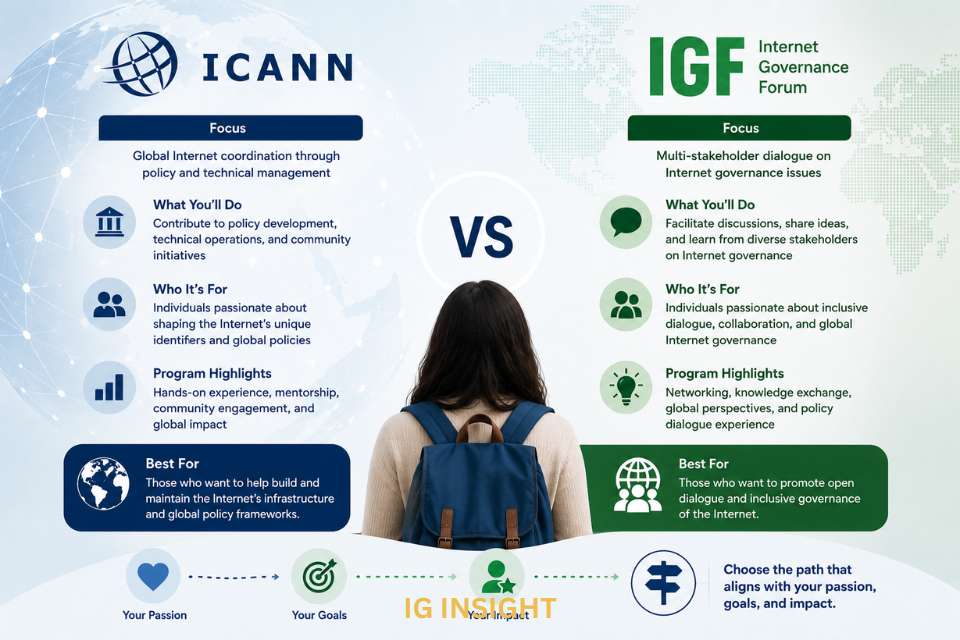
The ICANN Fellowship Program is designed to increase the diversity and depth of participation in ICANN’s policy development processes. Its core focus is equipping fellows with the knowledge, relationships, and institutional access needed to contribute meaningfully to the governance of the global domain name system. This is a technically and procedurally specific fellowship — ICANN’s work centres on DNS policy, and the fellowship prepares participants to engage with that work at a serious level.
Three fellowship cohorts are selected each year, one for each of ICANN’s public meetings. Fellows receive fully funded participation — including international travel, accommodation, visa support, and meeting registration — alongside a structured programme of mentoring, policy briefings, and orientation sessions that run before, during, and after the meeting.
Who Can Apply?
The ICANN Fellowship Program prioritises applicants from developing and emerging economies who have a demonstrated interest in internet governance and a clear rationale for how ICANN engagement would benefit their work or their community. There are no strict educational requirements or professional prerequisites. The programme actively seeks diversity across geography, gender, professional background, and sector — welcoming applications from civil society practitioners, government officials, academic researchers, technical professionals, and early-career individuals alike.
Crucially, prior ICANN experience is not required. The fellowship is explicitly designed as an entry point, not a reward for those who are already well-connected within ICANN circles. What selectors look for is genuine motivation, a plausible connection between ICANN policy and the applicant’s context, and evidence of commitment to sustained engagement beyond the fellowship meeting itself.
The Application Process
Applications open three times per year on a rolling cycle corresponding to each ICANN meeting. The standard application asks for a personal statement explaining why you want to participate in ICANN, what specific policy issues are relevant to your work or community, and what you plan to do with your fellowship experience in the longer term. Supporting materials typically include a short CV and a letter of endorsement from an organization or community relevant to your application.
The selection process is managed by the ICANN Fellowship Selection Committee, and decisions are communicated within six to eight weeks of the application deadline. Successful applicants receive a comprehensive pre-meeting orientation package, are matched with an experienced mentor from the ICANN community, and join a cohort of fellow participants with whom they navigate the meeting together.
- Applications: icann.org/fellowshipprogram — three cycles per year
- Coverage: International flights, accommodation, visa support, and meeting registration
- Mentoring: Each fellow is matched with an experienced ICANN community mentor
- Alumni network: ICANN Fellows Alumni Association (IFAA) provides ongoing community post-fellowship
- NextGen@ICANN: A parallel track for participants aged 18-30 focused on youth engagement

The IGF Fellowship Program
Purpose and Focus
The Internet Governance Forum Fellowship is structured differently from the ICANN programme in a way that reflects the IGF’s own nature. The IGF is a multi-stakeholder dialogue forum — broader in scope, less technically specific, and more explicitly focused on the full range of internet policy issues from cybersecurity and AI governance to digital inclusion and human rights online. The IGF Fellowship reflects this breadth: it is designed to bring voices from underrepresented communities into a global conversation that shapes internet policy norms worldwide, even without creating binding decisions.
The fellowship supports attendance at the annual IGF meeting — a five-day event involving more than ten thousand participants from over 180 countries, featuring hundreds of sessions across the full landscape of internet governance issues. Fellows attend the meeting with funded support and participate in pre-event preparation programmes that help them engage substantively rather than simply observe.
Who Can Apply?
IGF Fellowship eligibility is centred on representing voices and perspectives that are underrepresented in global internet governance discussions. This explicitly includes individuals from developing countries, from civil society and community organisations, from academic institutions in the Global South, and from technical communities that lack the resources to send representatives to international meetings. Gender diversity is a consistent priority, and there is dedicated space in fellowship cohorts for youth participants through the IGF’s Youth IGF Programme and Youth Ambassadors initiative.
Unlike the ICANN fellowship, the IGF programme does not require a specific connection to any particular policy domain. An applicant working on digital literacy in rural Senegal, a researcher studying platform governance in Southeast Asia, or a journalist covering cybersecurity policy in Latin America all represent exactly the kind of perspective the IGF fellowship is designed to bring into the room.
The Application Process
The IGF Fellowship application cycle opens annually, typically in the first half of the year with the annual meeting taking place in November or December. The application asks for a description of your work or community involvement related to internet governance, an explanation of how attending the IGF would benefit your context and the broader community you represent, and confirmation that you would face financial barriers to attending without fellowship support.
Decisions are made by the IGF Secretariat in consultation with regional and stakeholder community advisors. Fellows receive travel support, accommodation assistance, and access to pre-meeting capacity building sessions. Many IGF fellows describe the meeting itself as the most intensive networking and learning experience in their professional lives — the sheer density of expertise and diversity of perspective across five days is genuinely unlike any other event in internet governance.
- Applications: intgovforum.org — annual cycle, typically opens April-June
- Coverage: Travel support, accommodation assistance, meeting participation
- Youth track: Dedicated Youth IGF Programme and Youth Ambassador opportunities
- NRIs: Fellows often connect with National and Regional IGF initiatives in their home countries
- Intersessional engagement: Active fellows contribute to Dynamic Coalitions and Best Practice Forums year-round
The Internet Society (ISOC) Fellowship Program
Purpose and Focus
The Internet Society Fellowship to the IETF is among the most technically demanding fellowship opportunities in internet governance. The IETF — the Internet Engineering Task Force — is the body that develops and maintains the voluntary technical standards that make the internet work at the protocol level. Everything from the HTTP standard your browser uses to load websites, to the TLS encryption protecting your online banking, to the BGP routing protocol that directs internet traffic across the globe, was standardised through the IETF.
The ISOC Fellowship to the IETF therefore targets individuals with technical backgrounds who are ready to engage with the standards-development process itself. It is a pathway into one of the most consequential technical governance bodies on the planet — one that operates almost entirely through voluntary participation, open mailing lists, and consensus-based deliberation.
Who Can Apply?
The ISOC Fellowship to the IETF is specifically designed for technically capable individuals from developing and emerging economies who have the background to engage with IETF working groups but would not otherwise be able to attend the in-person meetings that, despite the IETF’s online-first culture, remain important for relationship-building and effective participation. Ideal applicants have existing familiarity with networking protocols, internet standards, or related technical fields and can demonstrate how IETF participation would advance their work or their country’s internet technical capacity.
ISOC also runs broader fellowship and grant programmes through its chapters and Foundation, including support for community network projects, digital rights advocacy, and internet access initiatives. These programmes are administered through the Internet Society Foundation and regional chapter networks, and they target a wider range of professional and community contexts beyond the specifically technical focus of the IETF fellowship.
The Application Process
The ISOC Fellowship to the IETF follows the IETF’s three-meeting annual calendar, with fellowship opportunities available for IETF meetings held in March, July, and November. Applications ask for a technical background summary, a description of relevant work in networking or internet standards, and an explanation of how IETF participation would benefit the applicant’s professional development and their broader technical community.
Selected fellows receive funding for travel and accommodation, access to a structured programme of IETF orientation sessions led by experienced community members, and mentoring from ISOC staff and IETF old-timers who help fellows navigate the sometimes daunting culture of IETF participation. Persistence is rewarded in this community — fellows who stay engaged through mailing lists and remote participation between meetings build the credibility needed to contribute substantively to working group deliberations.
- Applications: isoc.org/grants/fellowship-to-the-ietf — three cycles per year
- Coverage: Travel, accommodation, and IETF meeting registration
- Technical focus: Networking protocols, internet standards, IETF working group engagement
- ISOC Foundation grants: Broader grant programmes for internet access and digital rights work
- Chapter engagement: ISOC chapters in 150+ countries offer local fellowship and grant opportunities
ICANN vs IGF vs Internet Society Fellowships
| Feature | ICANN Fellowship | IGF Fellowship | Internet Society Fellowship |
|---|---|---|---|
| Organizing Body | Internet Corporation for Assigned Names and Numbers (ICANN) | Internet Governance Forum (IGF) | Internet Society |
| Primary Focus | Domain Name System (DNS), Internet identifiers, ICANN policymaking | Broad Internet governance and digital policy discussions | Internet development, leadership, technical capacity building |
| Purpose | Prepare participants to engage in ICANN’s multistakeholder processes | Enable diverse stakeholders to participate in global Internet governance dialogue | Develop future Internet leaders and strengthen regional communities |
| Typical Audience | Newcomers interested in ICANN policy and DNS issues | Government, civil society, academia, technical community, youth | Emerging leaders, community builders, and Internet advocates |
| Meeting/Event Supported | ICANN Public Meetings | Annual IGF Meeting | Various programs and events |
| Frequency | 3 times per year | Once per year | Depends on the specific fellowship program |
| Application Period | About 4–6 months before each ICANN meeting | Usually several months before the annual IGF | Varies by program |
| Program Duration | Around 7–8 days | About 5–7 days | From several weeks to several months |
| Number of Cohorts per Year | Three cohorts (one for each ICANN meeting) | One cohort annually | Multiple programs throughout the year |
| Training Before Event | Yes (webinars, mentoring, assignments) | Limited orientation sessions | Extensive online learning and mentoring (depending on program) |
| Mentorship Component | Strong mentorship structure | Moderate | Strong, varies by fellowship |
| Travel Support | Yes (airfare, hotel, per diem) | Yes | Usually yes, depending on the program |
| Post-Program Engagement | Fellows are expected to continue participating in ICANN communities | Encouraged to remain active in national and regional IGF initiatives | Alumni network and continued leadership opportunities |
| Policy Development Exposure | Very high | Moderate | Varies |
| Technical Training | Limited | Limited | Often strong, especially in technical programs |
| Networking Opportunities | ICANN Supporting Organizations and Advisory Committees | Global multistakeholder community | Internet Society Chapters and global network |
| Competitiveness | High | High | Moderate to high |
| Best For | Individuals seeking long-term engagement in ICANN policymaking and DNS governance | Those interested in broader Internet governance issues and global policy dialogue | People seeking leadership development, technical knowledge, and community-building skills |
How These Fellowships Benefit Communities — Beyond the Individual
The most important thing to understand about difference between ICANN, IGF, and Internet Society Fellowships in internet governance. As they are not designed to benefit only the individual fellow. They are designed to strengthen communities. When a fellow from Bangladesh attends an ICANN meeting and returns with a deep understanding of gTLD policy, they become a resource for their entire national internet community — informing registry operators, government agencies, civil society organisations, and the media about developments that will affect their country’s digital infrastructure.
IGF fellows often go on to help establish or strengthen National IGF initiatives in their home countries — grassroots governance forums that translate global internet policy debates into locally relevant conversations. IETF fellows return with the technical knowledge to train colleagues, contribute to national standards bodies, and participate in the remote deliberations that shape the protocols underlying all internet communication. And ISOC fellowship alumni frequently become the connective tissue between their local internet communities and the global governance ecosystem, serving as translators, advocates, and capacity builders across years of sustained engagement.
This ripple effect is why the three organisations invest in these programmes. The return on each fellowship is not measured in the individual’s career advancement alone — it is measured in the expanded diversity and depth of the communities that shape the internet’s future.
Which Fellowship Should You Choose?
| If you want to… | Best Fellowship |
|---|---|
| Learn how Internet policies affecting DNS are made | ICANN Fellowship |
| Participate in broad discussions on AI, cybersecurity, digital inclusion, and Internet governance | IGF Fellowship |
| Build leadership skills and gain technical expertise while joining a global network | Internet Society Fellowship |
| Become involved in regional and global Internet communities over the long term | All three complement each other |
Frequently Asked Questions
Q: Can I apply for more than one fellowship at the same time?
A: Yes — there is no formal restriction on applying simultaneously to the ICANN, IGF, and ISOC fellowship programmes. In practice, many internet governance professionals have participated in more than one programme over the course of their careers. However, each application should be tailored to the specific programme and should reflect a genuine alignment between the programme’s focus and your current work or context. A strong application to one programme typically requires clear specificity about that programme’s particular value to you — which is harder to achieve if you are submitting identical materials to multiple bodies simultaneously.
Q: Do I need prior experience in internet governance to apply?
A: For the IGF fellowship, no prior experience in internet governance is needed — the programme is explicitly designed as an entry point for new voices. For the ICANN fellowship, prior experience is not required, but applicants who can demonstrate a clear connection between ICANN’s policy work and their own professional or community context tend to be more competitive. For the ISOC Fellowship to the IETF, some technical background in networking or internet protocols is expected — this is the most technically demanding of the three fellowships and is not well-suited to applicants without any relevant technical grounding.
Q: What happens after the fellowship ends — is there ongoing support?
A: All three programmes have active alumni communities that provide continued engagement pathways. ICANN maintains the Fellows Alumni Association (IFAA), which organises alumni cohorts across meetings, creates mentoring relationships between incoming and returning fellows, and supports alumni participation in GNSO working groups and ICANN community roles. IGF fellows frequently continue their engagement through National and Regional IGF initiatives, Dynamic Coalitions, and Best Practice Forums that operate year-round. ISOC maintains ongoing relationships with IETF fellows through its chapter network and facilitates continued participation in IETF working groups through remote channels. The fellowship is a beginning, not an endpoint.
Q: What is the NextGen@ICANN programme and how is it different from the main fellowship?
A: NextGen@ICANN is a dedicated track within the ICANN fellowship programme specifically designed for participants between the ages of 18 and 30. It offers the same funded participation as the main fellowship but includes additional structured programming tailored to early-career professionals and students, including a NextGen session specifically focused on introducing participants to ICANN’s policy processes and community. NextGen participants are encouraged to take on specific engagement tasks during the meeting — drafting summary reports, participating in specific working group sessions, or contributing to ICANN’s social media coverage — which builds practical skills alongside the relationship and knowledge development that the main fellowship provides.
Q: How do these fellowships contribute to internet governance beyond the individual fellow’s career?
A: The long-term impact of these fellowship programmes is most visible in the communities fellows return to and the networks they build across cohorts. IGF fellows who establish national IGF dialogues bring global policy conversations into local contexts where they can be acted upon by governments, civil society, and businesses. ICANN fellows who go on to serve in GAC delegations, ccTLD management roles, or GNSO working groups bring perspectives that have materially changed policy outcomes. ISOC/IETF fellows who train their colleagues in networking protocols expand the technical capacity of their national internet communities. The programmes function as an infrastructure for distributed, global internet governance capacity — and the return on each individual fellowship investment compounds over years of sustained community engagement.
Your Next Step Into Internet Governance Starts Here
Three fellowships. Three pathways. One destination: a career and a community at the heart of the internet’s most important governance conversations.
If you want to shape domain name policy, understand ICANN’s contractual frameworks, and engage directly with the organizations that govern the global internet namespace, the ICANN fellowship is your entry point. If you want the broadest possible exposure to internet governance in all its dimensions — policy, rights, security, access, AI — the IGF fellowship puts you in the room where those conversations happen at global scale. And if your passion is the technical architecture of the internet itself, the ISOC Fellowship to the IETF takes you inside the standards-development process that underlies everything else.
None of these paths requires perfection. None requires a distinguished CV or an established network. They require genuine commitment, a clear articulation of why participation matters to you and to the community you represent, and the decision to apply.
Apply Now — The Internet Governance Community Is Waiting for You
Each fellowship cycle brings new opportunity. Do not wait for the perfect moment — start with the next open application.
- ICANN Fellowship: icann.org/fellowshipprogram
- IGF Fellowship: intgovforum.org/en/content/igf-2026-fellowship-programme
- ISOC IETF Fellowship: internetsociety.org/fellowships/
- Prepare with ICANN Learn: learn.icann.org
The internet’s future belongs to those who help build it. Take the first step.
© 2026 IG Insight Blog. This article is published for educational and informational purposes.

Dipankar Barua is an internet governance advocate from Dhaka, Bangladesh, who believes that voices from the Global South must be heard in the rooms where the internet’s future is decided. As an ICANN advocate and VSIG member, he actively engages in multistakeholder policy processes spanning DNS security, digital inclusion, and responsible AI governance. With an academic grounding in Computer Science and AI, and over 15 years of applied IT experience, Dipankar bridges the gap between technical communities and policy spaces — writing, participating, and advocating for a more open, equitable, and inclusive internet for all.