From complete beginners to returning alumni — the ICANN Fellowship Program is more open than you think. Here’s everything you need to know before you apply.
If you’ve been curious about getting involved in internet governance but feel like you don’t know where to start — or whether you’re even the right candidate — the ICANN Fellowship Program might be exactly what you’re looking for.
ICANN, the Internet Corporation for Assigned Names and Numbers, runs one of the most recognized fellowship programmes in the internet governance space. It has been bringing individuals from underserved and underrepresented communities into the heart of ICANN’s multistakeholder processes for over 15 years.
But who exactly qualifies as an ICANN Fellowship Program candidate? What do the different fellowship tracks involve? When does the programme open, and how many times can you apply? This guide answers all of that, drawing directly from ICANN’s official programme documentation so you have the complete picture before you submit a single word.
What Is the ICANN Fellowship Program?
The ICANN Fellowship Program is a structured participation and capacity-building initiative designed to strengthen the diversity of ICANN’s multistakeholder model. Its core mission is to foster opportunities for individuals from underserved and underrepresented communities to become active, engaged participants in the ICANN community rather than passive observers.
At its heart, ICANN is a multistakeholder organisation, meaning that internet governance decisions are made through the collective input of governments, civil society, the private sector, technical communities, and individual internet users worldwide. The Fellowship exists because that model only works well when the people in the room actually represent the full diversity of the internet’s global user base — and for much of ICANN’s history, that diversity has been uneven.
The programme does more than simply fund travel to an ICANN Public Meeting. Every accepted fellowship candidate receives:
- A dedicated mentor: Each fellow is matched with an experienced ICANN community member who guides them through the community’s structure, working groups, and policy processes before, during, and after the meeting.
- Structured training: Training spans the full fellowship period, covering ICANN’s policy development processes, DNS fundamentals, the structure of the supporting organisations and advisory committees, and practical skills for participating in technical and policy discussions.
- Travel assistance: Travel and accommodation support to attend the relevant ICANN Public Meeting, removing the financial barrier that would otherwise make participation inaccessible for many candidates from developing regions.
- Alumni network access: Completing the programme connects fellows to a global community of past participants who continue engaging with ICANN’s work and with each other after the formal programme ends.
What ICANN Expects in Return: The fellowship is not a passive experience. All selected candidates must engage in the mentoring process, complete additional ICANN Learn courses, attend required fellowship sessions at the Public Meeting, network actively with alumni and community members, and complete a post-meeting survey. The expectation is ongoing community contribution, not a one-time visit.
Who Can Apply? The Full Eligibility Scenario
One of the most important things to understand about the ICANN Fellowship Program is that candidates from all regions and sectors are welcome. This is explicitly stated on ICANN’s official programme page. You don’t need to be from a developing country, you don’t need a particular academic credential, and you don’t need to be a DNS expert before you apply.
That said, there are specific requirements every candidate must meet:
- You must be at least 21 years of age at the time of selection.
- You must be interested in, or already engaged in, ICANN’s work in policy building, the operation of the Domain Name System (DNS), or the security and stability of the global internet.
- You must complete mandatory ICANN Learn courses before being selected. These are free, self-paced online courses available through ICANN’s learning platform.
- You must NOT be involved in or associated with other ICANN supported travel programmes at the time of selection. Holding a parallel ICANN-sponsored travel award disqualifies you.
There are also fellowship-specific rules for returning applicants. Second and third-time fellowship applicants must demonstrate active involvement and engagement in one of the ICANN communities between their previous fellowship and their new application. Simply attending an ICANN meeting as a fellow and disappearing from the community afterward is not sufficient to qualify for a return fellowship.
Candidates who have already received a fellowship can apply a maximum of three times in total. The programme does not allow more than three fellowships per individual, and each subsequent application requires evidence of increasing community contribution.
The Different Fellowship Tracks: Community, Policy Forum, and NextGen
The ICANN ecosystem offers more than one participation pathway for newcomers and established professionals. Understanding the differences helps you identify which track you should pursue.
Community Fellowship (Standard Track)
This is the core ICANN Fellowship Program — the one most people mean when they refer to an ICANN fellowship. It is open to newcomers who have never participated in the programme before, as well as returning fellows applying for a second or third fellowship who meet the community engagement requirements.
The Community Fellowship is tied to the Annual General Meeting (AGM), which takes place each October and is the largest and most comprehensive ICANN meeting of the year. This is where the full breadth of ICANN’s supporting organisations, advisory committees, and working groups come together, making it the richest environment for a new fellow to be immersed in.
Policy Forum Fellowship (Alumni Only)
The Policy Forum is a separate, shorter ICANN meeting held mid-year, typically in June, focused specifically on policy development rather than the broad range of topics covered at the AGM. Crucially, Policy Forum fellowship candidates must have already successfully completed an ICANN Fellowship at a previous meeting.
This is an alumni-only track. If you are brand new to the programme, you cannot apply for a Policy Forum fellowship as your first fellowship — you must first complete a Community Fellowship at an Annual General Meeting and then apply for the Policy Forum in a subsequent round.
NextGen@ICANN (Student Track)
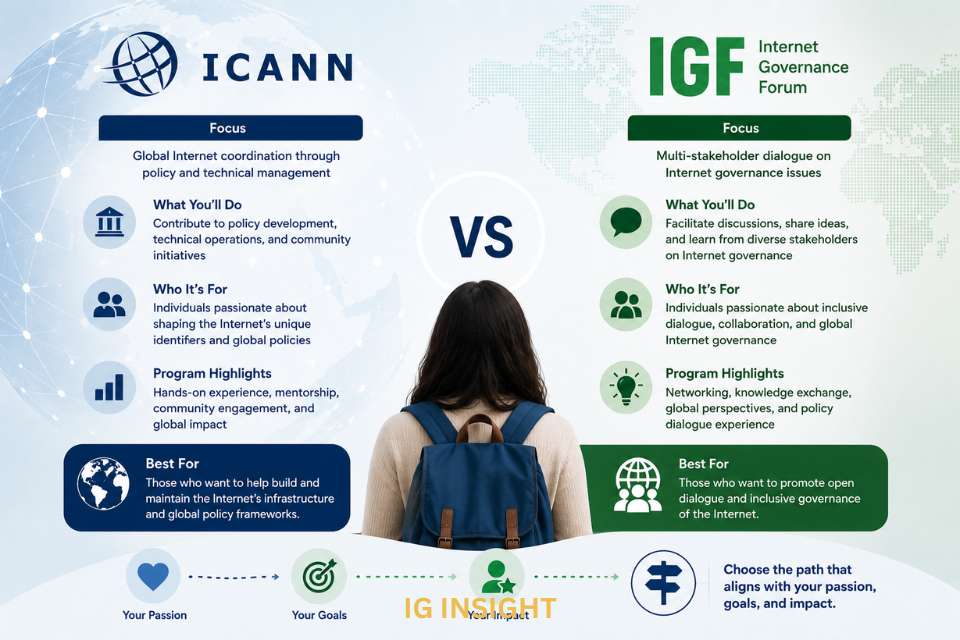
NextGen@ICANN is technically a separate programme rather than a fellowship track, but it’s closely associated and often confused with the Fellowship Programme. The distinction is straightforward: the Fellowship Program is for professionals and individuals already working in or interested in internet governance as practitioners, while NextGen is designed specifically for university-level students.
NextGen participants receive coaching and travel assistance to attend the ICANN Public Meeting taking place in their own region. The programme aims to engage the next generation of internet governance leaders while they are still studying, with the expectation that they will begin contributing to regional and global internet policy within one to two years following programme completion. If you are currently a university student, NextGen@ICANN is likely your entry point rather than the main Fellowship Program.
ICANN Fellowship Program Opening Times and Application Rounds
The ICANN Fellowship Program runs in cycles tied directly to ICANN’s annual calendar of Public Meetings. ICANN typically holds three Public Meetings per year: two Community Forums and one Annual General Meeting (AGM). Fellowship applications are opened specifically for each meeting, not on a rolling or year-round basis.
The general annual structure looks like this:
- ICANN Community Forum 1 (typically February to March): A regional community forum tied to a specific geographic region. Application rounds for this meeting typically open in October or November of the previous year.
- ICANN Policy Forum (typically June): The mid-year policy-focused meeting. Only fellowship alumni are eligible to apply, and the application round typically opens around March.
- ICANN Annual General Meeting (typically October): The main, largest meeting and the primary entry point for first-time fellowship candidates. Application rounds for the AGM typically open in March or April.
As a concrete historical example drawn from ICANN’s official published dates: the application round for ICANN72 (the Annual General Meeting in Seattle, USA) opened on 1 March 2021 at 23:59 UTC and closed on 30 March 2021 at 23:59 UTC, with selected fellows announced on 21 June 2021. Application windows are typically around 30 days in duration.
Key Timing Insight: ICANN does not maintain a perpetually open application portal. Applications are only accepted during specific, limited windows for each meeting. Missing a window means waiting for the next round. The best strategy is to monitor ICANN’s official Fellowship Program page at icann.org/fellowshipprogram and set reminders based on the planned launch dates ICANN publishes for upcoming rounds.
It’s also important to know that extraordinary circumstances can affect the programme’s schedule. During the COVID-19 pandemic, ICANN suspended applications for multiple meeting rounds and deferred selected fellows to future meetings. When ICANN meetings went fully virtual, the fellowship programme also moved to a virtual format, incorporating the key elements of mentorship and training in an online environment while postponing the in-person meeting experience until in-person gatherings resumed.
The Tarek Kamel Fellowship Recognition
Returning fellows who demonstrate outstanding contributions to ICANN’s capacity development efforts in their respective regions are eligible for the Tarek Kamel Fellowship Recognition. Named in honour of Dr. Tarek Kamel, a former ICANN board member and champion of internet development in the Arab world, this recognition acknowledges the fellows who go beyond completing the programme to become genuine ambassadors and community builders.
The recognition is not something you apply for separately — it is awarded by the Fellowship Selection Committee based on evidence of the impact a fellow has made after completing their fellowship, particularly in terms of sharing knowledge, mentoring others, and contributing to ICANN’s work in their home region or community.
Frequently Asked Questions
1. Do I need prior experience in internet governance or DNS to apply?
No. ICANN explicitly states that the Fellowship Program is open to candidates from all regions and sectors, and the programme’s own goal is to bring people who are underserved or underrepresented into the ICANN community. What you do need is genuine interest in ICANN’s work in policy building, the DNS, or internet security and stability, and you must be at least 21 years old. The mandatory ICANN Learn courses you complete during the application process are themselves designed to bring you up to speed, so a lack of prior technical knowledge is not a disqualifying factor.
2. How many times can I receive the ICANN Fellowship?
A maximum of three times. First-time applicants are classified as newcomers if they have never participated in the Fellowship Program before. Second and third-time applicants must demonstrate active involvement in an ICANN community between their fellowships — simply having received a fellowship previously is not sufficient on its own. The selection committee looks for evidence that you have been contributing to ICANN’s work in your region, not just attending meetings.
3. Can I apply for the Policy Forum Fellowship as my first application?
No. The Policy Forum fellowship is exclusively open to ICANN Fellowship alumni — individuals who have already successfully completed at least one ICANN Fellowship at a previous meeting. If you are applying for the first time, you must apply for the Community Fellowship tied to an Annual General Meeting. Once you have completed that fellowship, you become eligible to apply for the Policy Forum track in subsequent rounds.
4. What is the difference between the ICANN Fellowship and NextGen@ICANN?
The key difference is the target audience. The ICANN Fellowship Program is designed for professionals from all sectors and regions who are interested in or already engaged in internet governance. NextGen@ICANN is specifically designed for university-level students. Both programmes provide travel support and structured engagement at an ICANN Public Meeting, but NextGen is region-specific — it supports students from the region where the meeting is being held, whereas the Fellowship Program draws from all global regions. If you are currently enrolled as a university student, NextGen is typically your starting point rather than the main Fellowship Program.
5. Where do I apply, and how do I know when the application round opens?
Applications are submitted through ICANN’s official Fellowship Program page at icann.org/fellowshipprogram. The application portal is only active during specific, time-limited windows tied to each ICANN Public Meeting — there is no year-round open application. ICANN publishes planned launch dates for upcoming application rounds on the same page. The most reliable strategy is to bookmark that page, check it regularly from about six to eight weeks before a scheduled meeting, and subscribe to ICANN’s news updates, which will announce when a new application round opens. Application windows are typically around 30 days, so prompt action once a round opens is important.
Your ICANN Journey Starts Before the Application Opens
The ICANN Fellowship Program opens its application window for roughly 30 days per meeting round. That window is short, but what you do in the months before it opens determines how strong your candidacy actually is.
The most competitive ICANN Fellowship Program candidates don’t start preparing when the application opens. They start now.
Here’s your action plan:
- Visit icann.org/fellowshipprogram today and bookmark the page. Check the published dates for upcoming application rounds.
- Create a free ICANN account and start the mandatory ICANN Learn courses immediately — don’t wait for the application window.
- Identify your ICANN community: explore Supporting Organisations (GNSO, ccNSO, ASO) and Advisory Committees to find where your background fits best.
- Attend ICANN meetings virtually — they’re free to watch — to get familiar with the community culture and language before you apply.
- If you’re a student, explore NextGen@ICANN at icann.org/public-responsibility-support/nextgen as your entry point.
- Subscribe to ICANN news updates so you receive the application launch announcement the moment it’s published.
The internet is shaped by the people who show up. Be one of them.
Written by an internet governance professional committed to making ICANN’s multistakeholder model more accessible, transparent, and diverse.
© 2026 IG Insight Blog. This article is published for educational and informational purposes.

Dipankar Barua is an internet governance advocate from Dhaka, Bangladesh, who believes that voices from the Global South must be heard in the rooms where the internet’s future is decided. As an ICANN advocate and VSIG member, he actively engages in multistakeholder policy processes spanning DNS security, digital inclusion, and responsible AI governance. With an academic grounding in Computer Science and AI, and over 15 years of applied IT experience, Dipankar bridges the gap between technical communities and policy spaces — writing, participating, and advocating for a more open, equitable, and inclusive internet for all.