Same internet governance world. Completely different doors into it.
The complete guide to choosing the fellowship that matches your goals and background
You’ve heard that internet governance fellowships can transform careers. You’ve done enough research to know that both ICANN and the IGF offer fellowship programs — and now you’re facing the question that matters most: what actually is the difference between ICANN and IGF fellowships, and which one should you apply for?
It’s a genuinely important question, and one that doesn’t get answered clearly enough in most resources about internet governance participation. The two programs share a common purpose — breaking down barriers to participation in global internet governance — but they target different institutions, develop different skills, create different opportunities, and are suited to different professional backgrounds and goals.
This guide gives you the honest, specific comparison you need to make a well-informed decision about your first fellowship application — or your next one.
Two Fellowships, Two Different Institutions
Understanding the difference between these fellowships starts with understanding the difference between the institutions that run them, because the fellowship programs are direct reflections of their parent organisations.
ICANN — the Internet Corporation for Assigned Names and Numbers — is a technical coordination body with a specific, bounded mandate: managing the global domain name system, overseeing the allocation of internet identifiers, and developing policies that govern how domain names are registered, transferred, and operated. ICANN’s authority is real and binding within its domain. When ICANN adopts a policy through its multi-stakeholder process, that policy is contractually enforceable against the registries and registrars that operate within the ICANN ecosystem.
The IGF — the Internet Governance Forum — is a completely different kind of institution. Created by the United Nations in 2006 following the World Summit on the Information Society, it is a multi-stakeholder dialogue forum with no regulatory authority and no power to make binding decisions. What the IGF has instead is breadth, inclusivity, and legitimacy as the world’s largest open forum for discussing the full range of internet governance issues. Its annual meeting brings together over ten thousand participants from more than 180 countries to discuss everything from cybersecurity and AI governance to digital inclusion, human rights online, and the future of internet infrastructure.
| The Core Distinction: The ICANN fellowship takes you into an institution that makes binding policy decisions about the domain name system. The IGF fellowship takes you into the world’s broadest multi-stakeholder conversation about internet governance. One is more specific and technical; the other is broader and more dialogic. Both are genuinely valuable — they are just valuable in different ways. |
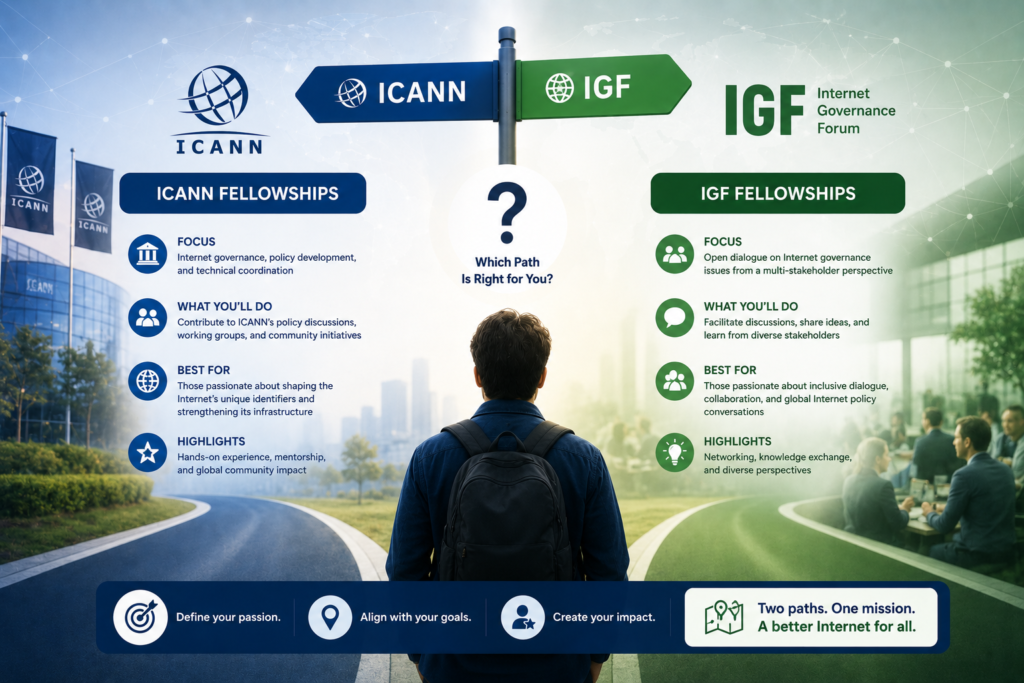
Key Differences of ICANN vs IGF Fellowships
| ICANN Fellowship | IGF Fellowship |
| Focus: DNS and domain name policy | Focus: All internet governance issues |
| Output: Binding contractual policies | Output: Non-binding dialogue and norms |
| Meetings: 3 per year (global rotation) | Meetings: 1 per year (global rotation) |
| Duration: 5-6 day meeting | Duration: 5 day annual meeting |
| Application: 3 cycles annually | Application: Annual cycle |
| Technical depth: Medium-high | Technical depth: Low-high (varies) |
| Prior IG experience: Not required | Prior IG experience: Not required |
| Youth track: NextGen@ICANN (18-30) | Youth track: Youth IGF / Ambassadors |
| Alumni network: IFAA (global) | Alumni network: NRI and DC engagement |
| Best for: Policy and DNS specialists | Best for: Broad IG newcomers and advocates |
Focus and Scope: The Most Important Difference
If there is one difference that matters more than any other when choosing between these two fellowships, it is the difference in scope.
The ICANN fellowship immerses you in a specific policy domain: the governance of the domain name system and internet identifiers. This is genuinely consequential work — ICANN’s policies affect how every domain name on the internet is managed, priced, disputed, and protected. But it is also a relatively bounded domain with its own technical vocabulary, institutional history, and procedural complexity. Coming out of an ICANN meeting as a fellow, you will understand how the GNSO policy development process works, who the key stakeholders are in the contracted parties houses and non-contracted parties houses, what the major open policy questions are in generic TLD governance, and how the ICANN Board relates to its community. You will have a foundation for contributing substantively to domain name policy.
The IGF fellowship is a completely different experience in terms of scope. The annual IGF meeting covers the full landscape of internet governance — cybersecurity and infrastructure resilience, digital rights and freedom of expression, AI governance and algorithmic accountability, digital inclusion and universal access, data protection and privacy, internet fragmentation and the multi-stakeholder model itself. There is no bounded domain to master before attending. Instead, fellows navigate a vast, rich conversation and identify the threads most relevant to their own work and community. Coming out of an IGF meeting as a fellow, you will understand the full breadth of internet governance issues, have met practitioners working across all of those domains, and have a much clearer picture of where your own interests and expertise can contribute to the field.
This difference in scope has a direct implication for which fellowship is right for you at which stage. If you already have a clear focus — you work on domain name policy, DNS security, registrar accountability, or ICANN’s policy processes specifically — the ICANN fellowship is the more targeted and immediately productive entry point. If you are new to internet governance and are still developing your focus, or if your work touches the internet in ways that do not map directly onto ICANN’s mandate, the IGF fellowship provides the broader foundation from which a more focused specialisation can emerge.
Why Do ICANN and IGF Offer Fellowship Programs?
Understanding why these institutions invest in fellowship programs helps clarify what they are genuinely trying to achieve — and what you can expect the institution to invest in you if you are selected.
Why ICANN Offers Fellowships
ICANN’s founding mandate includes a commitment to the multi-stakeholder model of internet governance — a model that is only legitimate if it genuinely represents the full diversity of the global internet community, not just the most powerful or most well-resourced stakeholders. The reality of ICANN participation, without financial support, is that it skews heavily toward actors from wealthy countries with large internet industries who can afford to send representatives to three international meetings per year. The fellowship program exists to correct that skew.
Beyond the equity rationale, ICANN also has a practical interest in developing a pipeline of informed, engaged community members who can contribute substantively to its policy processes. Working groups that include participants from developing economies, from civil society, and from technical communities outside the major commercial registrar and registry space produce better, more representative, and more legitimate policy outcomes. The fellowship is an investment in the quality of ICANN’s governance as well as its inclusivity.
Why the IGF Offers Fellowships
The IGF’s fellowship rationale is even more explicitly tied to its core purpose. The forum was designed from the beginning to be a place where every stakeholder group — governments, business, civil society, the technical community, and individual users — engages on equal terms. But equal formal standing does not produce equal actual participation when the costs of attendance are prohibitive for the majority of the world’s internet users. The fellowship program is the mechanism by which the IGF ensures that its dialogue is genuinely global rather than a conversation among the already-privileged.
The IGF also has a specific interest in youth participation and in amplifying voices from the Global South — both because these communities represent the largest and fastest-growing segments of the global internet user base, and because the internet governance decisions of the next decade will profoundly affect their digital futures. The youth tracks and dedicated regional fellowships within the IGF program are direct expressions of this priority.
Which Fellowship Should You Apply For? Key Factors to Consider
The honest answer is that there is no universal right answer — the best fellowship depends on your specific background, interests, and goals. But there are several factors that consistently help clarify the choice.
Your Current Level of Internet Governance Familiarity
If you are new to internet governance and do not yet have a specific policy domain focus, the IGF fellowship is almost always the better starting point. The breadth of the annual meeting gives newcomers an orientation to the entire landscape that would take years to develop through narrower engagement. The IGF fellowship is explicitly designed as an entry point for people at the beginning of their internet governance journey, and the meeting’s diversity of sessions and participants makes it exceptionally generative for someone who is still discovering where their interests and expertise fit.
If you already have experience with internet governance — if you have attended regional IGF events, engaged with internet policy through your professional work, or have been following ICANN’s policy development process — the ICANN fellowship provides the more focused and technically demanding experience that builds on that foundation.
Your Professional Background and Domain
The ICANN fellowship is most directly relevant to people whose work has a specific connection to domain names, internet naming policy, DNS security, registrar or registry operations, IP addressing, or related technical and legal areas. If your work is in digital rights, cybersecurity, AI governance, digital inclusion, community networks, online freedom of expression, or any of the dozens of other internet governance domains that fall outside ICANN’s specific mandate, the IGF fellowship is more directly aligned with your context.
That said, it is worth noting that ICANN’s policy processes affect everyone who uses the internet — domain registrants, businesses, civil society organisations, and individual users all have a stake in how domain name governance works. You do not need to be a technical DNS expert to contribute meaningfully to ICANN’s policy processes, and the fellowship will equip you with the institutional knowledge needed to engage constructively.
Your Geographic location and Community
Both fellowships prioritise participants from developing and emerging economies, and both are explicitly designed to amplify voices from regions that are underrepresented in global internet governance. The IGF’s National and Regional IGF initiatives mean that fellowship alumni from developing countries often play an important role in establishing or strengthening local internet governance forums — making the IGF fellowship a particularly high-leverage investment for participants from countries where national IGF capacity is still developing.
For participants from countries with active ccTLD registries or significant internet industry presence, the ICANN fellowship may provide more immediately relevant connections and policy influence pathways. The GAC (Government Advisory Committee), which is one of ICANN’s most important channels for government input on policy, includes representatives from every UN member state — and ICANN fellowship participation is often a first step toward more formal GAC engagement for government officials from developing countries.
- Apply to the ICANN fellowship if: you work on domain policy, DNS, IP addressing, or registrar/registry operations; you want to influence binding policy in internet naming governance; you have some internet governance background and want a more focused experience
- Apply to the IGF fellowship if: you are new to internet governance; your work spans multiple IG issues; you want the broadest orientation to the field; you are interested in establishing or contributing to a national or regional IGF in your home country
- Consider applying to both over time: many experienced IG professionals have participated in both programs, finding that the two experiences are highly complementary rather than competing
Frequently Asked Questions
Q: Can I apply to both the ICANN and IGF fellowship programs in the same year?
A: Yes, there is no formal rule preventing simultaneous applications. The two programs run on different timelines — the IGF fellowship typically has one annual cycle, while the ICANN fellowship runs three cycles per year — so the application windows rarely overlap directly. In practice, applying to both in the same year is most productive if you have specific, differentiated rationales for each program. Selection committees in both programs are experienced enough to distinguish between genuine applications tailored to their specific program and generic applications submitted to multiple programs without careful customisation. Each application should articulate specifically why that particular program is relevant to your work and goals.
Q: Is the ICANN fellowship more competitive than the IGF fellowship?
A: Both programs are competitive, but in slightly different ways. The ICANN fellowship runs three times per year, which means there are three opportunities annually to be selected, and the total number of fellows supported across the year is substantial. The IGF fellowship is an annual program, so competition is concentrated in a single application window. Selectivity in both programs depends heavily on the geographic and professional diversity of the applicant pool in any given cycle. For both programs, the quality and specificity of the application — not the number of credentials listed — is the primary determinant of selection.
Q: What is the NextGen@ICANN program and how does it relate to the main ICANN fellowship?
A: NextGen@ICANN is a dedicated participation track within the ICANN fellowship programme specifically for participants between the ages of 18 and 30. It provides the same funded access as the main fellowship — international travel, accommodation, meeting registration — but includes additional structured programming tailored to early-career professionals and students, including a dedicated NextGen session and structured engagement tasks during the meeting. The IGF has parallel youth-focused tracks including the Youth IGF Programme and Youth Ambassador opportunities. If you are under 30, you can consider applying to the age-specific track within whichever program is most aligned with your focus, while the main fellowship programs remain fully open to you as well.
Q: What happens after the fellowship — is there ongoing support from ICANN and the IGF?
A: Both institutions provide ongoing support structures for alumni, though the specific mechanisms differ. ICANN maintains the Fellows Alumni Association (IFAA), which organises alumni across meeting cohorts, facilitates mentoring relationships between incoming and returning fellows, and supports alumni participation in GNSO working groups and ICANN community roles. The IGF supports continued engagement through National and Regional IGF initiatives — many fellows go on to become active contributors to or coordinators of national IGF processes in their home countries, which provides year-round engagement in internet governance. Both institutions also provide remote participation channels for policy processes that continue between meetings, so fellowship alumni can remain engaged without needing to attend in person at every cycle.
Q: Do I need to choose between ICANN and IGF — or can my career involve both?
A: Many of the most effective internet governance professionals engage with both ICANN and the IGF as complementary parts of their work, not as competing choices. ICANN handles the technical coordination of the domain name system and makes binding policy; the IGF provides the broader multi-stakeholder dialogue context within which ICANN’s work is understood and evaluated. Professionals who understand both institutions are better positioned to bridge technical DNS policy and broader internet governance conversations — and that bridging capacity is genuinely valuable. Over time, participating in both fellowships and building relationships within both communities creates a more comprehensive professional network and a richer understanding of how internet governance functions across its full range of institutions and processes.
Two Doors Into the Same House
The ICANN and IGF fellowships are not competitors. They are two different doors into the same house — the global community of people who care about how the internet is governed and are doing something about it.
The ICANN fellowship takes you through the door marked ‘DNS policy’ — into a specific, technically rich, and procedurally structured institution where binding decisions are made about the naming infrastructure that underlies all internet communication. The IGF fellowship takes you through the door marked ‘internet governance dialogue’ — into the broadest, most inclusive, and most diverse conversation happening anywhere about the future of the digital world.
Both doors open into the same community. Both lead, over time, to the same kind of career — one shaped by sustained, meaningful engagement with the institutions, processes, and people that govern the internet. The right door to walk through first is the one that matches where you are now, what you know, and what you want to contribute.
The door is open. The application is waiting. The community is ready to welcome you.
Choose Your Fellowship — and Start Building Your IG Career Today
The next application cycle is open. Your community is waiting. The internet needs your voice.
- Apply for ICANN Fellowship: icann.org/fellowshipprogram
- Apply for IGF Fellowship: intgovforum.org/en/content/igf-fellowship-programme
- Prepare with ICANN Learn: learn.icann.org
- Find your national IGF: intgovforum.org
The right fellowship is the one you apply to. Take the first step.
© 2026 IG Insight Blog. This article is published for educational and informational purposes.

Dipankar Barua is an internet governance advocate from Dhaka, Bangladesh, who believes that voices from the Global South must be heard in the rooms where the internet’s future is decided. As an ICANN advocate and VSIG member, he actively engages in multistakeholder policy processes spanning DNS security, digital inclusion, and responsible AI governance. With an academic grounding in Computer Science and AI, and over 15 years of applied IT experience, Dipankar bridges the gap between technical communities and policy spaces — writing, participating, and advocating for a more open, equitable, and inclusive internet for all.