From Geneva UN residencies to Asia-Pacific technical programmes — the internet governance fellowship landscape is wider than most people realise. Here’s how to navigate it.
So you’ve decided you want to get serious about internet governance. You’ve attended a few webinars, maybe participated in your national IGF, and you’re ready to step up to a more structured, funded pathway. The question is: which fellowship do you actually apply for?
It’s not an easy question, because the answer depends entirely on who you are, what you’ve already done, and what kind of career you’re building. There are fellowships for policy researchers and fellowships for network engineers. Fellowships tied to the United Nations and fellowships run by regional technical bodies. Fellowships open to everyone and fellowships restricted to specific regions or age groups.
In this guide, I’ll map out the main fellowships available in the internet governance space, explain what each one actually involves, when they open, and give you a clear framework for deciding which one is right for your specific profile. Let’s cut through the noise.
How Many Internet Governance Fellowships Are Actually Available?
More than most people starting out in this space realise. While ICANN and the IGF tend to dominate search results and forum discussions, there are at least six well-established, internationally recognised fellowship programmes operating in the internet governance and internet technical community space, plus a growing number of regional and national-level opportunities tied to local IGF initiatives and School of Internet Governance (SIG) programmes around the world.
The major programmes broadly cluster into three categories. First, there are global multistakeholder fellowships tied to the largest international internet governance bodies — ICANN and the IGF. Second, there are technical community fellowships run by regional internet registries and standards organisations — primarily APNIC in the Asia-Pacific region. Third, there are civil society and youth-focused programmes run by organisations like the Internet Society, whose Youth Ambassador Programme has been running annual cohorts tied to the IGF since 2019.
Below each other regional and sub-regional SIG events — EuroSSIG in Europe, INSIG in India, and Ghana SIG in West Africa — also run fellowship or scholarship tracks, though these tend to be more targeted geographically and shorter in format.
The Key Fellowship Programmes: What Each One Actually Is
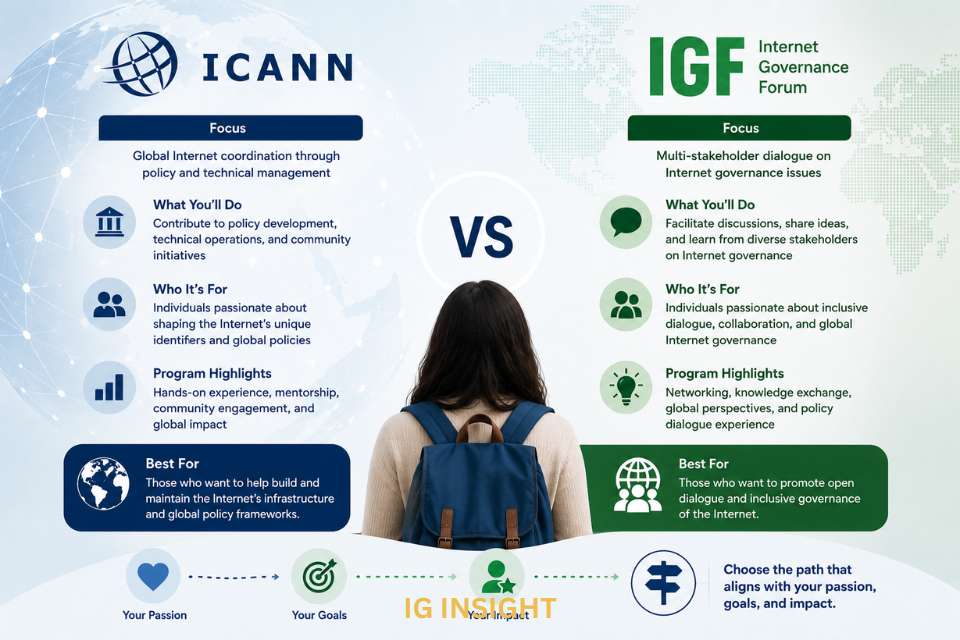
ICANN Fellowship Programme — ICANN — multistakeholder, global
Run by ICANN, the Internet Corporation for Assigned Names and Numbers, this is the most widely known fellowship in the DNS and naming policy space. It comes in two tracks.
Community Fellowship: Open to professionals from all regions and sectors aged 21 or above with interest in DNS policy and internet governance. Fellows receive mentorship, structured training, and travel support to attend an ICANN Public Meeting. Applications open approximately three rounds per year, tied to ICANN’s meeting calendar. Application windows are typically 30 days. Candidates must complete mandatory ICANN Learn courses before selection.
Policy Forum Fellowship: Alumni-only track for the mid-year Policy Forum meeting. You must have already completed at least one ICANN Community Fellowship to be eligible. This track is focused on deeper policy process engagement.
NextGen@ICANN (related programme): Separate from the Fellowship but closely associated. Designed specifically for university students, not working professionals. Region-specific: supports students from the region hosting the upcoming ICANN Public Meeting.
Opening time: Three rounds per year. AGM applications typically open March–April. Policy Forum applications typically open around March. Monitor icann.org/fellowshipprogram.
IGF Fellowship Programme — Internet Governance Forum / UN DESA, Geneva
Hosted at the IGF Secretariat in Geneva, Switzerland, this is the most immersive and operationally intensive fellowship available in the internet governance space. Fellows work full-time for six months inside the team that runs the annual IGF meeting. Up to two six-month cycles are offered per year (January–June and/or July–December).
The 2026 fellowship covers the period May to November 2026. Applicants must submit a CV, motivation letter, and the official nomination form. Candidates come from developing countries, LDCs, LLDCs, and transitional economies. A university degree in ICT or international affairs and at least two years of relevant professional experience are required. French language skills are desirable. Fellows cannot engage in any other employment, fellowship, or non-IGF meeting participation during the programme.
Opening time: The 2026 deadline was 31 March 2026. Applications submitted to vacancies@intgovforum.org. Monitor intgovforum.org for future rounds.
Internet Society Youth Ambassador Programme — Internet Society, global
Each year, the Internet Society selects fifteen young people (ages 18–30) to participate in a 12-month programme equipping the next generation of internet governance leaders. Ambassadors receive online internet governance training, mentorship from senior internet leaders, access to a global peer network, and funded travel to a significant internet event tailored to their profile and location.
Selection is competitive and two-phase: first a blind application review by a committee of ISOC staff, alumni, and Chapter leaders, then an online Internet Governance course for the highest-scoring candidates. The 15 top-rated course participants are selected as Ambassadors. Fellows must commit at least four hours per week for the full year and cannot have previously been an ISOC IGF Ambassador, Youth Ambassador, or Youth@IGF Fellow.
Opening time: Applications open each fall, typically in November. For the 2026 cohort, the window was 18 November to 2 December 2025, with programme kick-off in January 2026. Monitor internetsociety.org/policy-programs/youth-ambassadors.
APNIC Fellowship Programme — APNIC — Asia Pacific region
The Asia Pacific Network Information Centre (APNIC) runs the most technically-oriented of the major internet governance fellowships. APNIC provides fellowships in three categories: professional, youth, and returning (alumni). A Policy Fellowship stream was launched in 2025, with a new intake planned for 2026.
Fellows receive structured learning activities, engagement with international experts, and financial support to attend the APNIC annual conference. The 2026 APNIC Fellowship combines project-based learning and conference participation, with APNIC 62 taking place in Mumbai, India in September 2026. Note that you can only apply for one type of APNIC Fellowship per year. The programme is restricted to members of the Asia Pacific internet community in the APNIC service region, with emphasis on participants from emerging and developing economies.
Opening time: Annual applications open in early each year tied to APNIC’s conference calendar. Monitor apnic.net/community/fellowship.
Regional SIG Fellowships & Scholarships — EuroSSIG, INSIG, Ghana SIG and others
Several regional Schools of Internet Governance (SIGs) offer fellowships or scholarship tracks for their annual programmes. These are shorter, more geographically focused, and often structured as intensive training schools rather than ongoing fellowships, but they represent important entry points for regional practitioners.
EuroSSIG (European Summer School on Internet Governance): Annual summer school programme for internet governance practitioners in and around Europe. Applications typically open in spring. Check eurossig.eu.
INSIG (India School of Internet Governance): India-focused capacity building programme with fellowship tracks for civil society and government practitioners. Check insig.in for current intake details.
Ghana SIG: West Africa-focused SIG programme targeting digital policy professionals from the sub-region. Check ghanasig.org for application details.
Which Fellowship Should YOU Apply For?
Here’s the practical framework. Answer these three questions and your answer becomes much clearer:
Three Questions to Decide:
1. What is your professional background — policy, technical, or civil society/youth?
2. Which geographic region are you based in?
3. What stage of your career are you at right now?
- If you’re a DNS/naming policy professional or want ICANN-community engagement: Apply for the ICANN Community Fellowship. It’s the most direct entry point to ICANN’s multistakeholder processes and is the only fellowship that builds deep familiarity with how GNSO, ccNSO, and ICANN’s advisory committees actually work.
- If you’re a policy researcher from a developing country wanting UN-system immersion: Apply for the IGF Fellowship. This is the most prestigious and operationally intensive programme available, placing you inside the team that runs global internet governance dialogue. Requires at least 2 years of professional experience.
- If you’re 18–30 and building your career in internet governance: The Internet Society Youth Ambassador Programme is designed precisely for you. It’s competitive (15 spots globally), covers a full year, and connects you to a global network of internet governance leaders.
- If you’re a network engineer or technical professional in the Asia-Pacific region: The APNIC Fellowship Programme is your strongest option, particularly if you want to engage with number resource policy, routing security, or IP address governance in the APNIC service region. The newer APNIC Policy Fellowship stream is worth monitoring if your work bridges technical and policy domains.
- If you’re based in Europe or South Asia: EuroSSIG and INSIG are excellent entry points that require less commitment than full-year fellowships and may be more accessible as a first step before applying for the larger global programmes.
- If you’re already an ICANN fellow and want to deepen policy engagement: Apply for the ICANN Policy Forum Fellowship in a subsequent round, which requires you to demonstrate active community involvement between your fellowships.
One thing worth knowing: most experienced internet governance practitioners have engaged with multiple fellowship programmes across their careers — starting with a regional SIG, moving to an ICANN or ISOC fellowship, and eventually engaging with the IGF process. These aren’t mutually exclusive pathways; they build on each other.
Frequently Asked Questions
1. Which organisation offers the most internet governance fellowships?
ICANN offers the highest number of fellowship intake rounds per year, with up to three application windows tied to its annual meeting calendar. However, in terms of breadth of programming across different fellowship types and career stages, APNIC is notable for offering three fellowship categories (professional, youth, and returning alumni) plus a dedicated Policy Fellowship stream introduced in 2025. The Internet Society’s annual Youth Ambassador Programme also runs consistently year on year. For depth and immersion, the IGF Fellowship at the UN Secretariat in Geneva is unique and unmatched in format, but it is the most selective in terms of experience requirements.
2. Can I apply for more than one fellowship at the same time?
For most programmes, there’s no formal restriction preventing you from applying to multiple fellowships from different organisations simultaneously, since they are independently administered. However, a few important restrictions apply within individual programmes: the ICANN Fellowship prohibits parallel participation in other ICANN-supported travel programmes; the IGF Fellowship explicitly prohibits accepting any other fellowship, employment, or non-IGF Secretariat meeting participation during the six-month programme; and APNIC explicitly states you can only apply for one type of APNIC Fellowship per year. Always read the terms carefully and never accept more than one overlapping programme without checking both organisations’ rules.
3. Do I need to be a citizen of a developing country to apply?
Not for all programmes. ICANN explicitly states that candidates from all global regions and sectors are welcome. The Internet Society Youth Ambassador Programme is open globally. However, the IGF Fellowship specifically targets professionals from developing countries, LDCs, LLDCs, and transitional economies, making geographic eligibility a formal criterion. The APNIC Fellowship prioritises participants from emerging and developing economies within the APNIC service region. Regional SIG programmes like EuroSSIG, INSIG, and Ghana SIG are typically focused on their specific geographic regions. Reading each programme’s eligibility criteria carefully before investing time in an application is always worthwhile.
4. How do I strengthen my application across any of these fellowships?
The single most consistent signal of a competitive candidate across all these programmes is demonstrated community involvement at the national or regional level before applying. Whether that means active participation in your national IGF, contributing to ISOC Chapter activities, volunteering at a regional SIG, or writing and publishing on internet governance topics, evidence of existing engagement makes your application stand out. Most fellowships are looking for candidates who will multiply the impact of their experience — not just benefit from it personally — so a clear, specific plan for how you will use the fellowship to contribute back to your community is essential.
5. Are these fellowships paid, and what exactly is covered?
None of these programmes pay a salary. What they provide is funded participation. The ICANN Fellowship covers travel assistance to an ICANN Public Meeting. The IGF Fellowship covers the full six-month Geneva placement through the IGF Trust Fund. The Internet Society Youth Ambassador Programme covers funded travel to a selected internet event. APNIC covers financial support for its annual conference and structured learning activities. The regional SIG fellowships and scholarships typically cover programme fees, accommodation, and sometimes travel within the region. Always confirm what specifically is covered before accepting an offer, as package details can vary by cohort and year.
Find Your Fellowship. Build Your Seat at the Table.
The internet governance space needs more people from more places with more backgrounds. Every one of these fellowship programmes exists because the organisations running them know that the decisions shaping the internet’s future are better when they’re made by a room that actually reflects the people who use it.
You don’t need to wait until you’re perfect. You need to start building the profile that makes you competitive, and that starts now.
Your action plan:
- Identify which fellowship fits your background using the three-question framework above.
- Bookmark the official application page for your target fellowship and note the next opening date.
- Get involved at the national or regional level NOW — national IGFs, ISOC chapters, and regional SIG events all strengthen any application.
- Start the free ICANN Learn courses if ICANN is your target — completing them before the window opens gives you a real advantage.
- For ISOC Youth Ambassador, monitor internetsociety.org/policy-programs/youth-ambassadors from October onwards.
- Share this guide with one colleague in your network who deserves a seat in these rooms.
The best time to start preparing for an internet governance fellowship was last year. The second-best time is today.
Written by an internet governance practitioner who believes the most important rooms in this field should always have more doors.
© 2026 IG Insight Blog. This article is published for educational and informational purposes.

Dipankar Barua is an internet governance advocate from Dhaka, Bangladesh, who believes that voices from the Global South must be heard in the rooms where the internet’s future is decided. As an ICANN advocate and VSIG member, he actively engages in multistakeholder policy processes spanning DNS security, digital inclusion, and responsible AI governance. With an academic grounding in Computer Science and AI, and over 15 years of applied IT experience, Dipankar bridges the gap between technical communities and policy spaces — writing, participating, and advocating for a more open, equitable, and inclusive internet for all.