You do not need a law degree, a tech background, or a government title
A practical guide to participating in the process that governs the internet's address system
Most people assume that internet policy is made by governments in closed meetings, or by tech giants lobbying behind the scenes. The reality at ICANN — the organization that coordinates the global domain name system — is deliberately, structurally different.
ICANN’s foundational commitment is to the multi-stakeholder model of governance: a system in which the people who use the internet have a formal, meaningful voice in the policies that govern it. That includes you. Not as a passive recipient of decisions made by others, but as a participant who can submit comments, join working groups, attend meetings, and advocate for outcomes that serve the public interest.
This guide explains the real pathways through which internet users can contribute to ICANN policymaking — what those pathways look like, why civil society has fought hard to keep them open, and how you can start using them today.
Why Internet User Participation in ICANN Matters?
ICANN’s policies govern how domain names are registered, priced, disputed, and protected. They determine what top-level domains exist, what obligations registrars have toward their customers, and how personal data associated with domain registrations is handled. In a world where your email address, your business website, and your digital identity all depend on the domain name system, these are not narrow technical questions. They are questions about access, privacy, affordability, and power.
Without active user participation, those questions get answered primarily by the contracted parties — registries and registrars — who have a direct commercial interest in the outcomes. Civil society advocates have been making this argument since ICANN’s founding in 1998, and the institutional structure ICANN has built in response is one of the most open policy systems of any global technical body. But open structures only produce representative outcomes when people actually use them.
| The Core Principle: ICANN’s multi-stakeholder model gives every internet user a formal role in the governance of the domain name system. Participation is not a courtesy extended by the institution — it is a structural right built into ICANN’s bylaws and operating procedures. Civil society fought for those rights, and sustaining them requires people to exercise them. |
How Internet Users Can Contribute to ICANN Policymaking?
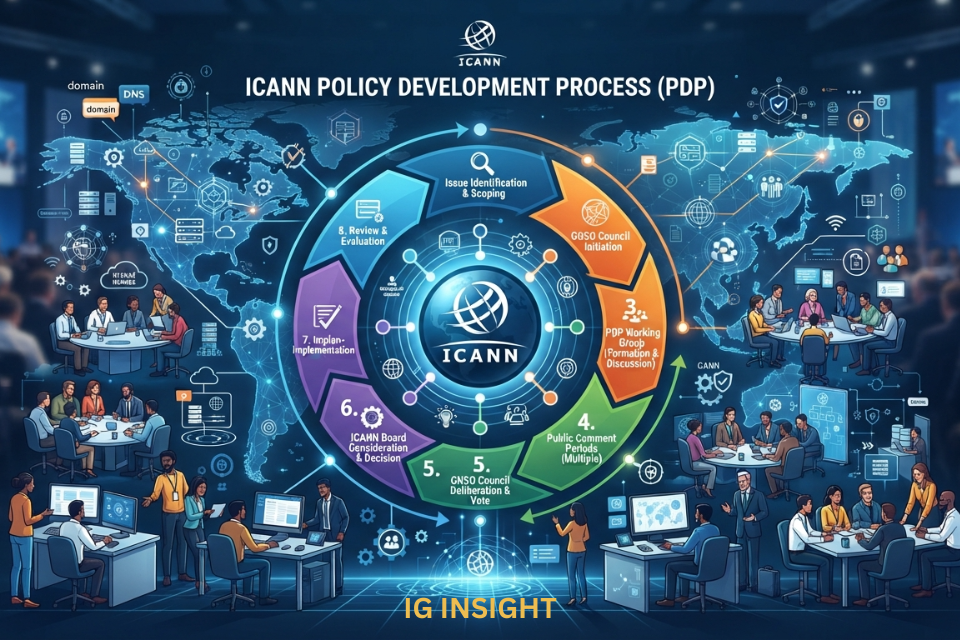
ICANN’s policy development process offers multiple entry points, ranging from low-commitment actions that take minutes to sustained engagement that can build into a career in internet governance. Here is the practical landscape.
Public Comment Submissions
The most accessible contribution any internet user can make to ICANN policymaking is a public comment submission. Every significant policy proposal, every new TLD application process, and every major contractual change at ICANN goes through a formal public comment period — typically four to six weeks during which anyone in the world can submit written input through ICANN’s online comment system.
Public comments are not symbolic gestures. They become part of the formal policy record, and working groups are required to address substantive comments in their Final Reports. A well-reasoned comment from an individual internet user in Dhaka, Lagos, or Buenos Aires can and does influence policy outcomes — particularly when it raises perspectives or impacts that have not been adequately considered in the working group’s deliberations.
The ICANN public comment portal is at icann.org/public-comments. All open comment periods are listed with deadlines, context documents, and submission instructions. Comments can be as short as one focused paragraph or as detailed as a multi-page technical analysis. What matters is specificity and relevance, not length.
The At-Large Community — ICANN’s User Representation Structure
The At-Large community is the formal institutional home for individual internet user participation at ICANN. It is organized through Regional At-Large Organizations (RALOs) covering five regions: Africa (AFRALO), Asia-Pacific (APRALO), Europe (EURALO), Latin America and the Caribbean (LACRALO), and North America (NARALO). These RALOs, in turn, aggregate input from hundreds of individual At-Large Structure (ALS) organizations — civil society groups, internet user associations, digital rights organizations, and community networks from around the world.
At-Large representatives participate formally in ICANN’s policy development process. They serve on GNSO working groups, submit formal positions to the ICANN Board, and provide input on strategic and budgetary decisions. The At-Large Advisory Committee (ALAC) — the apex body of the At-Large community — has formal liaison relationships with all of ICANN’s Supporting Organizations and Advisory Committees, giving individual user advocates structured access to every dimension of ICANN governance.
Joining your regional RALO, or helping your organization become an At-Large Structure, is one of the most effective ways for individual users to move from occasional comment submission to sustained, recognized participation in ICANN policymaking.
Working Group Participation
ICANN’s Policy Development Process is driven by working groups — open, volunteer-staffed bodies that research issues, deliberate on policy options, and produce the consensus recommendations that ultimately bind ICANN’s contracted parties. Working groups are genuinely open to public participation. You do not need to be a domain registrar, a government official, or a technology company employee. You need to apply, commit to active participation, and contribute substantively to the deliberations.
Working groups operate primarily through regular teleconference calls and email lists, making participation accessible to people anywhere in the world regardless of travel budget. Calls are recorded and archived, documents are publicly accessible, and the mailing list discussions — which are where much of the substantive work happens — are open to read for anyone who wants to follow along before deciding to participate.
Active working groups at any given time might be addressing topics ranging from DNS abuse mitigation and WHOIS privacy policy to the governance framework for a new round of generic TLDs. The GNSO’s working group charters and current working groups are all listed publicly on the ICANN website.
ICANN Meetings and Remote Participation
ICANN holds three public meetings per year, rotating across world regions. Each meeting spans five to six days and includes working group sessions, plenary presentations, stakeholder meetings, and open forums where any community member can address the ICANN Board directly. In-person attendance provides the relationship-building opportunities that are hardest to replicate remotely — and ICANN’s Fellowship Program exists specifically to make in-person participation financially accessible to qualified participants from developing economies.
For those who cannot attend in person, robust remote participation infrastructure is provided for every session. Adobe Connect rooms, recordings, transcripts, and chat participation tools allow remote participants to follow and contribute to substantive discussions in real time. Remote participation is not a second-tier experience — many of the most influential contributors to ICANN working groups have participated primarily or entirely remotely throughout their engagement.
Civil Society in ICANN: Role, Contributions, and What It Has Won!
Civil society’s engagement with ICANN is not a recent development or a marginal presence. It is woven into ICANN’s institutional design from the beginning, and it has produced concrete policy outcomes that directly benefit ordinary internet users around the world.
The Role of Civil Society in ICANN’s Public Policy
Civil society organizations — digital rights advocates, consumer protection groups, academic researchers, community network operators, and non-profit advocacy organizations — perform several distinct functions in ICANN’s governance ecosystem. They represent perspectives that would otherwise be absent from a policy process dominated by industry actors: the interests of ordinary domain name registrants, the privacy rights of individuals, the needs of communities in developing economies, and the long-term public interest in an open and interoperable internet.
Within the GNSO, civil society voices are primarily channeled through the Non-Commercial Stakeholders Group (NCSG), which includes the Non-Commercial Users Constituency (NCUC) and the Not-for-Profit Operational Concerns Constituency (NPOC). The NCSG holds seats in both houses of the GNSO Council, giving civil society a formal vote in the policy recommendations that reach the ICANN Board.
Civil society organizations also engage through the At-Large community, through academic research and independent technical analysis, and increasingly through direct Board-level engagement during ICANN meetings’ public sessions. The accumulation of these contributions — over more than two decades — has materially shaped ICANN into an institution that takes user rights more seriously than it would have without that sustained pressure.
What Civil Society Has Won at ICANN
The policy gains attributable to civil society and user community advocacy at ICANN are substantial and documented. The WHOIS privacy framework — which governs how personal data associated with domain registrations is collected, stored, and disclosed — was fundamentally reformed after years of civil society advocacy highlighting the privacy risks of making registrant data publicly available in a searchable, scrapable database. The reformed framework, built around GDPR compliance and privacy-by-design principles, protects millions of individual domain registrants from data brokers, stalkers, and other malicious actors who previously harvested WHOIS data at scale.
The community-based new TLD category — designed to enable genuine community-controlled domain spaces for geographic, linguistic, and cultural communities — was established in the new gTLD program after sustained civil society advocacy for alternatives to purely commercial TLD governance. Organizations representing indigenous communities, regional cultures, and underrepresented languages have been able to apply for TLDs that would not exist under a purely market-driven namespace expansion.
Universal Acceptance — the technical and policy initiative ensuring that all valid domain names, including those written in non-Latin scripts, function correctly in all software applications — has been kept on ICANN’s active agenda through persistent civil society and At-Large advocacy. For the billions of internet users whose primary language uses a non-ASCII script, this is not an abstract technical matter. It determines whether the internet functions in their language at all.
| Civil Society Impact: The reformed WHOIS privacy framework, the community TLD category, Universal Acceptance advocacy, and developing-country user access initiatives are all direct products of civil society and user community engagement in ICANN policymaking. These outcomes were not given — they were won through sustained, informed, organized participation. |
Your Practical Pathway Into ICANN Policymaking
Getting started does not require years of preparation or institutional affiliation. Here is a realistic sequence for moving from internet user to active ICANN policy participant.
The first step is awareness. Follow ICANN’s announcements on its website and social media channels. Subscribe to the relevant GNSO mailing lists for issues that interest you — even just reading the traffic builds familiarity with the issues, the arguments, and the participants. ICANN Learn (learn.icann.org) offers free, self-paced courses covering everything from DNS basics to ICANN’s governance structure to how the policy development process works. Completing even two or three relevant modules before your first substantive engagement will make the experience significantly more productive.
The second step is a first submission. When a public comment period opens on an issue relevant to your context — whether that is domain pricing, registrar accountability, DNS abuse, WHOIS privacy, or TLD governance — write and submit a comment. Keep it focused on your specific experience or expertise. A comment from someone who registers and uses domain names as a small business owner, a researcher, or a civil society practitioner carries a different and valuable kind of weight from comments submitted by industry actors.
The third step is community connection. Find your regional RALO and explore what it would mean to join as an individual or to affiliate your organization as an At-Large Structure. Attend an ICANN meeting remotely — even following one day of sessions gives you a sense of the culture, the key participants, and the issues under active discussion. If you are from a developing economy and want to attend in person, apply to the ICANN Fellowship Program.
- Subscribe to ICANN Announcements and one GNSO mailing list aligned with your interests
- Complete at least two ICANN Learn modules before your first public comment submission
- Submit your first public comment within 30 days of identifying an open consultation
- Connect with your regional RALO to find established advocates and ongoing working groups
- Attend one ICANN meeting session remotely — the public comment forum during any meeting is the ideal starting point
The Internet Needs Your Voice in Its Governance
ICANN’s Policy Development Process is one of the most open, participatory governance systems of any global institution. The pathways for internet users to contribute to ICANN policymaking are real, accessible, and consequential. The policies that govern your domain name, your digital identity, and the stability and security of the internet’s addressing infrastructure are shaped — in part — by people who decided to show up and engage.
Civil society organizations have fought for decades to ensure that governance channels remain open and that user voices carry formal weight. They have won important protections and created lasting policy frameworks that benefit billions of internet users. But those gains are not permanent unless people continue to use the channels that civil society has secured.
Your experience as an internet user, your perspective as a member of your community, and your knowledge of how the domain name system affects people in your context are valuable contributions to a conversation that shapes the internet for everyone. The only prerequisite is the decision to participate.
Frequently Asked Questions
Q: Do I need technical knowledge about DNS to participate in ICANN policymaking?
A: Not necessarily, though some familiarity with basic DNS concepts is helpful for engaging substantively in technical policy discussions. ICANN’s policy process covers a wide range of issues — from consumer protection and privacy to community governance and pricing — where lived experience as a domain user, civil society practitioner, or public policy professional is as valuable as technical expertise. ICANN Learn provides free courses that build the technical foundation you need at whatever pace suits you. Many of the most influential civil society voices at ICANN came from human rights, legal, or community development backgrounds rather than technical ones.
Q: What is the At-Large Advisory Committee and what power does it have?
A: The At-Large Advisory Committee (ALAC) is the apex body of ICANN’s At-Large community, representing the interests of individual internet users in ICANN’s governance structure. It is composed of representatives from the five Regional At-Large Organizations (RALOs) and has formal liaison relationships with the GNSO Council, the ccNSO, the GAC, and other ICANN bodies. The ALAC submits formal positions on ICANN policy consultations, engages the ICANN Board directly during public sessions, and contributes to ICANN’s strategic and budget planning processes. While the ALAC does not hold binding votes in the GNSO Council’s formal decision-making, its substantive contributions to working group deliberations and its direct Board engagement make it a meaningful force in ICANN policymaking.
Q: How has ICANN’s WHOIS privacy reform benefited ordinary users?
A: Before the WHOIS privacy reform — driven primarily by the GDPR compliance requirement and years of civil society advocacy — anyone who registered a domain name had their personal contact details (name, email, address, phone number) published in a publicly searchable database accessible to anyone in the world. This created significant risks: data harvesting by spam companies, targeted advertising, doxxing risks for activists and journalists, and privacy violations for anyone who registered a domain with their personal information. The reformed framework, implemented through ICANN’s Temporary Specification for gTLD Registration Data (now the Registration Data Policy), restricts public access to registrant data, requires registrars to have legitimate purposes for data collection, and aligns ICANN’s practices with international data protection standards. Tens of millions of domain registrants now have meaningfully stronger privacy protections as a direct result.
Q: What is the ICANN Fellowship Program and can I apply?
A: The ICANN Fellowship Program provides fully funded participation — including travel, accommodation, visa support, and registration — for selected applicants to attend ICANN public meetings. It is designed for individuals from developing and emerging economies who have a genuine interest in contributing to internet governance and ICANN policy but face financial barriers to in-person participation. Three fellowship cohorts are accepted annually, corresponding to ICANN’s three meetings. Fellows receive structured mentoring, policy briefings, and ongoing support for continued engagement after the meeting. Applications are open to individuals from any background — no prior ICANN experience is required, and both early-career professionals and established practitioners are eligible.
Q: What is the NCSG and how is it different from the At-Large community?
A: The Non-Commercial Stakeholders Group (NCSG) is a constituency within the GNSO (Generic Names Supporting Organisation) specifically representing non-commercial users of the domain name system — civil society organizations, academic institutions, not-for-profit operators, and individual non-commercial users. The NCSG holds formal voting seats in the GNSO Council, giving it a direct role in the binding policy recommendations that reach the ICANN Board. The At-Large community, by contrast, represents the broader individual user community across all stakeholder categories and engages primarily through advisory rather than voting channels. Both are important, complementary pathways: the NCSG for civil society organizations wanting a formal voting role in generic TLD policy, and At-Large for individuals and organizations seeking the broadest possible engagement across all of ICANN’s work.
Start Contributing to ICANN Policy Today
The internet was built for everyone. Its governance should reflect everyone. Your first step takes minutes.
- Submit a public comment: icann.org/public-comments
- Join the At-Large community: atlarge.icann.org
- Learn for free: learn.icann.org
- Apply for Fellowship: icann.org/fellowshipprogram
- Explore GNSO Working Groups: gnso.icann.org/en/group-activities/active
Policy made without you is policy made about you. Change that today.
© 2026 IG Insight Blog. This article is published for educational and informational purposes.

Dipankar Barua is an internet governance advocate from Dhaka, Bangladesh, who believes that voices from the Global South must be heard in the rooms where the internet’s future is decided. As an ICANN advocate and VSIG member, he actively engages in multistakeholder policy processes spanning DNS security, digital inclusion, and responsible AI governance. With an academic grounding in Computer Science and AI, and over 15 years of applied IT experience, Dipankar bridges the gap between technical communities and policy spaces — writing, participating, and advocating for a more open, equitable, and inclusive internet for all.