Inside the global system that lets ordinary people shape the internet's rules
A plain-English guide to ICANN's multi-stakeholder governance engine
Here is a question most internet users never think to ask: who writes the rules for how domain names work, how registrars are held accountable, or whether your email address can be written in Arabic script?
The answer is not a government. It is not a tech corporation. And it is not a small group of insiders making decisions behind closed doors. The answer is a structured, open, and genuinely participatory process called the ICANN Policy Development Process — and understanding how it works is one of the most practical things any internet stakeholder can do.
This post breaks it down clearly: what the process is, how it runs step by step, what it means for communities around the world, and how you can get involved.
What Is the ICANN Policy Development Process?
ICANN — the Internet Corporation for Assigned Names and Numbers — coordinates the technical underpinnings of the global domain name system. But managing a system used by billions of people requires more than technical expertise. It requires legitimate, transparent, and accountable policy-making. That is exactly what the ICANN Policy Development Process, commonly shortened to PDP, is designed to deliver.
The PDP is the formal mechanism through which ICANN’s community develops, debates, and adopts the policies that govern domain names, registrars, registries, and internet identifiers. It is not a legislative process — ICANN has no governmental authority. But within its specific mandate, the policies that emerge from the PDP are binding on the contracted parties that operate within the ICANN ecosystem.
| Key Principle: The ICANN Policy Development Process is built on the multi-stakeholder model — a governance philosophy that gives governments, private sector actors, civil society, the technical community, and individual users a formal voice in shaping policy. No single group dominates. Consensus, not majority vote, is the goal. |
How Does ICANN Run the Policy Development (PDP)Process?
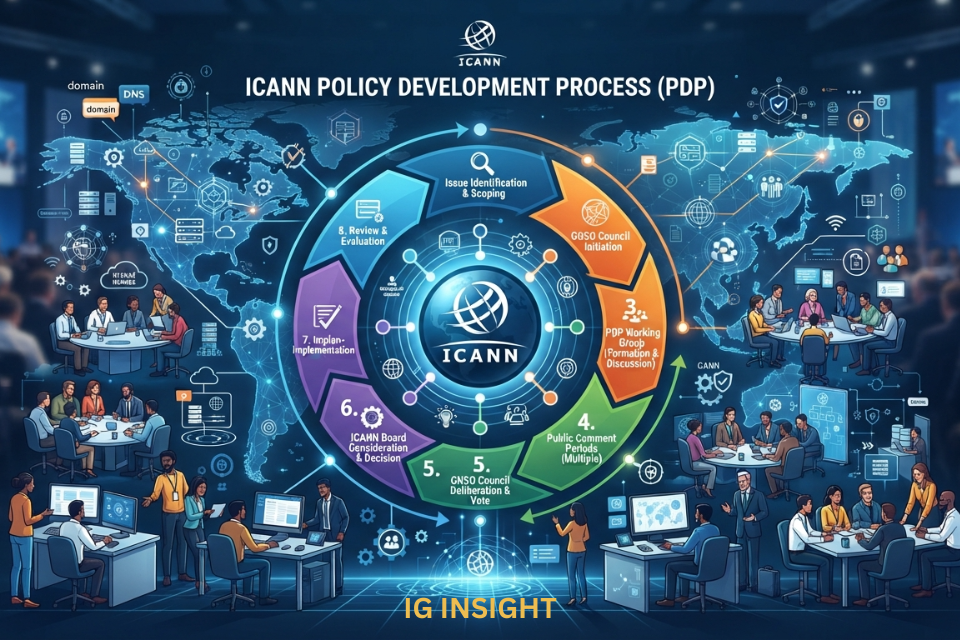
The PDP is not a single track — it runs differently depending on whether the policy being developed relates to generic TLDs (gTLDs) or country-code TLDs (ccTLDs). The primary policy-making bodies are the Generic Names Supporting Organisation (GNSO) for gTLDs and the Country Code Names Supporting Organisation (ccNSO) for ccTLDs. Most of the detailed public discussion happens through the GNSO, so that is where we will focus.
Stage 1: Issue Identification and Initiation
Every policy cycle begins with a recognized need. Issues reach the GNSO Council in several ways — from community petitions, from recommendations in previous reports, from ICANN staff analysis, or from the GNSO Council itself identifying a gap or problem in existing policy. Once a formal issue is identified and confirmed to fall within ICANN’s scope, the Council votes on whether to initiate a full Policy Development Process.
This initiation vote is important. It confirms that the issue genuinely requires new or revised policy — not just clearer implementation guidelines or a contractual update. If approved, a working group is formed to carry out the work.
Stage 2: The Working Group — Where the Real Work Happens
Working groups are the engine room of the ICANN Policy Development Process. They are open to anyone with a substantive interest in the issue — community members, business representatives, civil society advocates, government officials, technical experts, and individual internet users. There are no membership fees and no eligibility barriers. You apply to join, commit to participating actively, and contribute.
Working groups operate over months or sometimes years, holding regular calls, producing written deliberations, circulating draft recommendations, and seeking input from the broader community at every significant milestone. The goal is not speed — it is thoroughness and legitimacy. When a working group reaches consensus on a recommendation, that consensus has been tested against diverse perspectives from around the world.
| Open Participation: Working groups accept applications from anyone. All calls are recorded and archived. All documents are publicly accessible. This is not performative transparency — it is structural openness designed to ensure that the policies produced reflect the full range of stakeholder interests, not just those of the loudest or best-resourced participants. |
Stage 3: Public Comment
At multiple points during the PDP — and especially when an Initial Report is published — the working group’s draft recommendations are opened for public comment. Anyone in the world can submit written input through ICANN’s public comment system. Comments are logged, made publicly visible, and must be formally addressed by the working group in its Final Report.
This is not a token gesture. Public comment periods have materially changed the direction of ICANN policies. When significant stakeholder communities push back on a draft recommendation with substantive arguments, working groups are expected to engage seriously with those arguments — either revising their recommendations or explaining clearly why they have not.
Stage 4: Final Report and GNSO Council Vote
When the working group’s deliberations are complete, it produces a Final Report containing its consensus recommendations (and, where full consensus was not reached, the range of positions and the reasoning behind the working group’s preferred approach). This report goes to the GNSO Council, which reviews it and votes on whether to approve the recommendations for forwarding to the ICANN Board.
The GNSO Council is itself a multi-stakeholder body, divided into a Contracted Parties House (registries and registrars) and a Non-Contracted Parties House (representing business users, individual users, civil society, and intellectual property interests). Recommendations that receive support from both houses carry the strongest mandate.
Stage 5: ICANN Board Adoption
The ICANN Board is the final decision-making authority. When it receives GNSO Council-approved recommendations, it reviews them for consistency with ICANN’s bylaws, mission, and public interest obligations. In the overwhelming majority of cases, the Board adopts community-developed recommendations without modification — because the PDP is designed to produce legitimate consensus that the Board can act on with confidence.
If the Board decides not to adopt a recommendation, it must provide detailed written justification and typically must consult with the community before any alternative course of action is taken. This accountability mechanism is a critical safeguard against governance capture by any single actor.
What Does the ICANN Policy Development Process Mean for Communities?
The PDP is not an abstract institutional exercise. Its outputs directly affect how the internet works for real people and organizations around the world. The policies developed through this process determine how domain names are registered, transferred, and disputed. They determine what obligations registrars and registries have toward users. They determine how new top-level domains are introduced and governed. They determine the rules around domain privacy, data access, and abuse prevention.
For the global south and underrepresented communities, the PDP has been particularly significant in two areas. First, internationalized domain names — the policies enabling domain names written in Arabic, Chinese, Devanagari, and other scripts were shaped through ICANN’s community processes. Second, Universal Acceptance — the work ensuring that new and non-ASCII domain names function properly in all software — moves forward precisely because community advocates have engaged persistently in ICANN policy forums.
For civil society organizations, the PDP provides a formal channel to push back against policies that would harm users — whether that means fighting for meaningful WHOIS privacy protections, advocating for responsible DNS abuse frameworks, or ensuring that new TLD policies do not favor incumbent commercial interests at the expense of the public.
For governments, the Government Advisory Committee (GAC) provides a structured channel to offer advice to the GNSO Council and the ICANN Board on public policy dimensions of any given issue. GAC advice carries significant weight — if the Board disagrees with a GAC consensus position, it must engage in a formal dialogue process before proceeding differently.
How to Get Involved in the ICANN Policy Development Process?
Getting involved in ICANN’s policy work is more accessible than most people realize. The process was designed to be open — and ICANN actively supports participation from stakeholders who might otherwise face barriers.
The most direct entry point is the ICANN At-Large community — a global network of individual internet user organizations that provides a formal voice for end users in ICANN processes. At-Large Regional Organizations (RALOs) operate on every continent, and joining your regional RALO gives you a pathway into working group participation, public comment processes, and ICANN meeting engagement.
You can also engage directly through ICANN’s public comment system without joining any formal body. Every open PDP consultation is listed on ICANN’s website with submission instructions, deadlines, and guidance documents. A single substantive public comment from an informed stakeholder contributes to the record and must be addressed by the working group.
ICANN meetings — held three times a year in rotating global locations — are another critical participation venue. They include working group sessions, policy briefings, fellowship opportunities, and networking events that build the relationships underlying effective community participation. ICANN’s Fellowship Program provides funded travel and structured mentoring for participants from developing economies who wish to engage but face resource barriers.
- Join an ICANN GNSO Stakeholder Group aligned with your interests: registries, registrars, business users, non-commercial users, intellectual property, or internet service providers
- Apply to serve on an active working group via the GNSO Working Group Charter page
- Submit public comments on open consultations at icann.org/public-comments
- Attend ICANN meetings — remotely via Adobe Connect or in-person through the fellowship program
- Engage with your national or regional IGF to connect ICANN policy work with local internet governance advocacy
| For New Participants: ICANN Learn (learn.icann.org) offers free online courses covering DNS fundamentals, ICANN’s structure, and how the Policy Development Process works. Completing a few modules before attending your first working group call will make the experience significantly more productive. |
Why the ICANN Policy Development Process Matters!
At its core, the ICANN Policy Development Process matters because it is one of the clearest working examples of the multi-stakeholder internet governance model in action. In an era where governments are increasingly asserting national control over internet infrastructure, and where large platforms exercise enormous de facto power over digital spaces, the PDP represents something genuinely different: a process in which power is formally distributed, accountability is structural, and participation is open.
This matters not just as a philosophical ideal but as a practical safeguard. The policies that govern domain names affect freedom of expression, access to information, consumer protection, and economic opportunity for billions of people. If those policies were developed purely by governments through intergovernmental treaty processes, or by a small group of industry insiders, the outcomes would systematically favor the most powerful actors. The PDP’s design — imperfect as its implementation sometimes is — exists specifically to prevent that.
The process also matters in the context of WSIS+20, the 2025 review of the World Summit on the Information Society. As the international community debates the future of internet governance and the balance between multi-stakeholder and intergovernmental approaches, the ICANN PDP stands as one of the strongest pieces of evidence that a bottom-up, community-driven governance model can produce legitimate, technically sound, and globally applicable policy at scale.
Imperfections exist, of course. Participation is still heavily weighted toward English-speaking, technically sophisticated actors from wealthy countries. Working group processes can be slow and procedurally opaque to newcomers. And the boundary between ICANN’s narrow technical mandate and broader internet policy questions is sometimes contested. But these are reasons to engage and improve the process — not reasons to abandon it.
Frequently Asked Questions
Q: Who can participate in the ICANN Policy Development Process?
A: Anyone with a substantive interest in internet naming policy can participate. There are no nationality requirements, no membership fees for most participation channels, and no technical credentials required. The most formal participation routes are through GNSO Stakeholder Groups (representing registries, registrars, business users, non-commercial users, intellectual property interests, and ISPs) and the At-Large community (representing individual internet users). Anyone can also submit public comments on open consultations without joining any formal group. ICANN’s Fellowship Program provides funded participation support for those from developing economies who face resource barriers.
Q: How long does a typical ICANN Policy Development Process take?
A: The duration varies significantly depending on the complexity and controversy of the issue. Relatively straightforward policy amendments may complete in 12 to 18 months. Complex, multi-year efforts — such as the ongoing work on the next round of new generic TLDs or the comprehensive WHOIS policy review — have taken five years or more. The PDP deliberately prioritizes thoroughness over speed, because policies that emerge from rushed processes without genuine consensus tend to require costly revisions. ICANN has made procedural improvements over the years to reduce unnecessary delays while maintaining the deliberative quality that gives PDP outputs their legitimacy.
Q: Are ICANN policy decisions legally binding?
A: ICANN’s policies are binding on the contracted parties — registries and registrars — that operate under agreements with ICANN. These are legally enforceable contractual obligations, not government regulations. ICANN cannot directly regulate internet users, content, or national laws. However, because ICANN contracts cover the operation of virtually all major generic TLDs, the policies have global practical effect for anyone who registers or uses a domain name. Country-code TLD operators have a different relationship with ICANN — many operate with significant autonomy — but typically align with community norms developed through similar processes.
Q: What is the difference between the GNSO PDP and the ccNSO PDP?
A: The Generic Names Supporting Organisation (GNSO) runs the PDP for generic top-level domains — .com, .org, .net, .shop, and all the other TLDs not assigned to specific countries or territories. The Country Code Names Supporting Organisation (ccNSO) runs a parallel but distinct process for country-code TLDs like .uk, .de, or .bd. The ccNSO process tends to be more advisory in nature, reflecting the greater autonomy that national ccTLD operators have traditionally exercised. Both processes share the multi-stakeholder participation philosophy, but their structures, timelines, and the binding force of their outputs differ meaningfully.
Q: What happens if the ICANN Board does not follow the GNSO’s policy recommendations?
A: This is rare but not without precedent. When the ICANN Board declines to adopt a GNSO Council recommendation, it is required under ICANN’s bylaws to provide a detailed written explanation of its reasoning and to engage in a structured dialogue with the GNSO before pursuing any alternative course. The Board’s accountability to the community is reinforced by several mechanisms in ICANN’s post-2016 accountability framework — including the ability of the GNSO community to trigger an Independent Review Process if it believes the Board has acted inconsistently with ICANN’s mission or bylaws. In practice, the Board and community work hard to reach alignment before formal recommendations are made, minimizing the frequency of public disagreements.
The Process Is the Point
The ICANN Policy Development Process is not perfect. But it is one of the internet’s most important democratic institutions — a place where the rules governing the global name system are built in public, by a community, with accountability mechanisms that matter.
Every policy that emerges from the PDP carries the legitimacy of genuine deliberation. Every stakeholder who participates actively makes that legitimacy stronger. And in a period when the internet’s governance is contested from multiple directions — by authoritarian governments seeking control, by powerful platforms asserting private authority, and by fragmentation pressures threatening global interoperability — a functioning, participatory ICANN Policy Development Process is not just valuable. It is essential.
Your Voice Belongs in Internet Policy
ICANN’s Policy Development Process only works when diverse voices show up. Yours matters — wherever you are in the world.
- Explore open consultations: icann.org/public-comments
- Join ICANN At-Large: atlarge.icann.org
- Apply for ICANN Fellowship: icann.org/fellowshipprogram
- Learn the basics free: learn.icann.org
The internet’s rules are written by those who show up. Start today.
© 2026 IG Insight Blog. This article is published for educational and informational purposes.

Dipankar Barua is an internet governance advocate from Dhaka, Bangladesh, who believes that voices from the Global South must be heard in the rooms where the internet’s future is decided. As an ICANN advocate and VSIG member, he actively engages in multistakeholder policy processes spanning DNS security, digital inclusion, and responsible AI governance. With an academic grounding in Computer Science and AI, and over 15 years of applied IT experience, Dipankar bridges the gap between technical communities and policy spaces — writing, participating, and advocating for a more open, equitable, and inclusive internet for all.