You use the internet every single day. But have you ever stopped to wonder — who actually decides how it works? Who makes the rules? Who decides what websites can exist, what languages are supported, or how your data flows across borders?
The short answer: it’s complicated. And that complexity has a name — internet governance.
Internet governance is one of the most consequential and least understood topics in modern public life. It shapes everything from the price of your broadband to your right to free speech online, from the security of your banking app to whether billions of people in the Global South get to use the internet in their own language.
What Is Internet Governance? The Official Definition
The most widely cited definition of internet governance comes from the 2005 World Summit on the Information Society (WSIS). It defines internet governance as:
| WSIS Definition (2005): The development and application by governments, the private sector, and civil society, in their respective roles, of shared principles, norms, rules, decision-making procedures, and programmes that shape the evolution and use of the Internet. |
Internet governance is the set of rules, norms, standards, and processes — and the institutions that develop them — that determine how the internet is built, operated, accessed, and used. It covers everything from the technical standards that make your browser work, to the policies that determine who can register a domain name, to the international negotiations over who controls internet infrastructure.
Internet Governance Is NOT:
- A single government controlling the internet (no such thing exists)
- A global internet police force or regulator
- Just about censorship or content moderation (though those are part of it)
- Something only experts and diplomats need to care about
Internet Governance IS:
- A multi-stakeholder ecosystem of institutions, forums, and communities
- Technical coordination (how IP addresses, domain names, and protocols are managed)
- Policy development (how rules about data privacy, cybersecurity, and access are made)
- Political negotiation (how nations compete and cooperate over internet infrastructure and norms)
- Civil society advocacy (how ordinary people push for an open, free, and fair internet)
Why Does Internet Governance Matter to You?
Here’s a reality check: every time you go online, internet governance decisions are affecting your experience. Whether you notice it or not.
| Scale of Impact: As of 2025, there are approximately 5.5 billion internet users worldwide — representing roughly 68% of the global population. The decisions made in internet governance forums directly affect all of them. |
- Your privacy: Whether companies can sell your browsing data is shaped by internet governance decisions — from GDPR in Europe to national data protection laws influenced by global frameworks.
- Your access: Whether people in rural Bangladesh, remote Kenya, or island communities in the Pacific can afford reliable internet is shaped by spectrum policy, infrastructure investment decisions, and universal access frameworks — all products of internet governance.
- Your security: The technical standards that prevent hackers from hijacking your connection (DNSSEC, RPKI, TLS) exist because of international technical standards bodies and network operator communities working through governance processes.
- Your free speech: Whether your government can order an internet shutdown, block social media, or demand platforms censor speech is contested in internet governance forums — from the IGF to ITU to national regulatory bodies.
- Your language: Whether you can access the internet in Arabic, Hindi, or Chinese — using domain names in your own script — is a Universal Acceptance and internet governance challenge being actively worked on right now.
Internet Governance: Key Facts & Figures
| Fact | Detail |
| Internet users worldwide (2025) | ~5.5 billion — 68% of the global population |
| Internet traffic per day | ~5.4 exabytes (5,400,000,000 GB) daily |
| Domain names registered | ~360 million+ across all TLDs globally |
| IPv4 exhaustion | All five Regional Internet Registries have depleted free IPv4 pools |
| IPv6 deployment | ~45% of Google users reach Google over IPv6 (2024) |
| WSIS milestones | World Summits: Geneva 2003, Tunis 2005; WSIS+20 review in 2025 |
| IGF established | 2006, under UN mandate from WSIS; renewed through 2025 |
| ICANN founding | 1998, replacing US government direct control of DNS |
| IANA transition | 2016: historic transfer of IANA functions to global community |
| Internet shutdowns | 180+ government-ordered shutdowns globally in 2023 (NetBlocks) |
| Digital divide | ~2.6 billion people remain offline — mostly in Global South |
| AI governance | Emerging as the top new internet governance priority for 2025+ |
The Three Pillars of Internet Governance
Internet governance sits at the intersection of three distinct but overlapping domains. Understanding these helps you see why it’s so complex — and so important.
Pillar 1: Technical Governance
This covers the standards, protocols, and infrastructure that make the internet technically work. Without technical governance, packets wouldn’t route, emails wouldn’t deliver, and websites wouldn’t load.
- IP addresses and domain name system (DNS) coordination — managed by ICANN and the RIRs
- Internet protocols (TCP/IP, HTTP, TLS, BGP) — standardized by the IETF
- Routing security (RPKI, DNSSEC) — developed by technical communities and deployed by ISPs
- Root servers — the 13 logical root server clusters that anchor the entire DNS system
Pillar 2: Policy Governance
This covers the rules, laws, and norms that shape how the internet is used — who can access it, what content is permitted, how data is handled, and how the internet economy operates.
- Data protection and privacy laws (GDPR, PDPA, CCPA, and their global equivalents)
- Cybersecurity regulations and incident response frameworks
- Digital trade and cross-border data flow rules
- Content moderation standards and intermediary liability frameworks
- Universal access and affordable connectivity policies
Pillar 3: Political & Geopolitical Governance
This is where internet governance meets international relations. Nations, blocs, and alliances are increasingly competing over who controls internet infrastructure, data, and norms.
- Digital sovereignty debates: who controls data generated on a nation’s soil
- Internet fragmentation risk: the so-called ‘splinternet’ concern
- ITU vs. multi-stakeholder model debates: government-centric vs. open governance
- UN Global Digital Compact and WSIS+20 negotiations
- Sanctions, export controls, and their effects on internet technology access
The Multi-Stakeholder Model Explained
One of the most distinctive and debated features of internet governance is the multi-stakeholder model. Unlike most areas of international governance, the internet is NOT primarily governed by governments negotiating treaties.
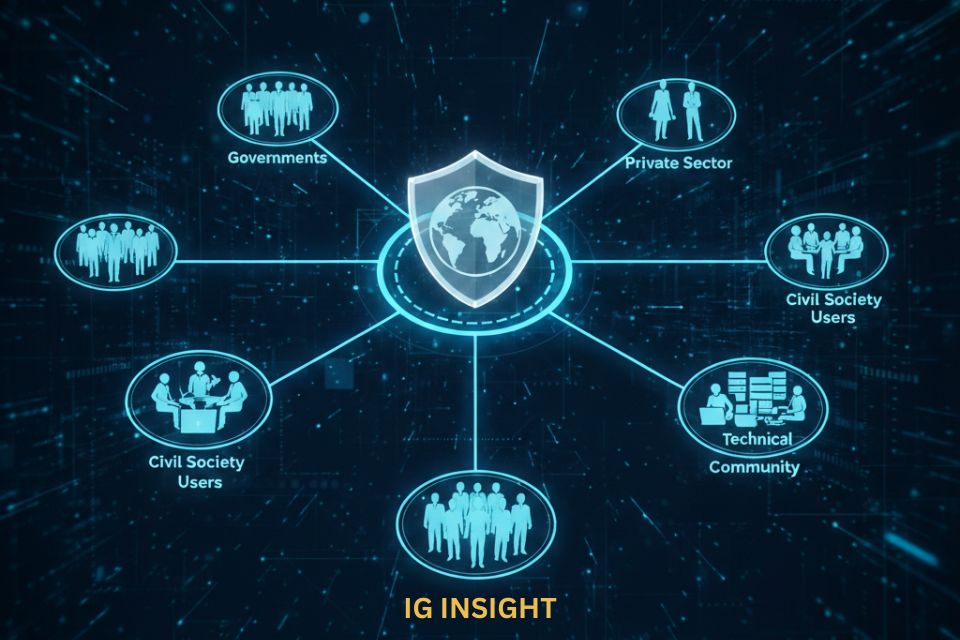
Instead, it operates through a multi-stakeholder model in which governments, the private sector, civil society, the technical community, and academic institutions all participate — in theory as equals.
| 💡 Why It Matters: The multi-stakeholder model is why ICANN’s Board includes representatives from every world region and every stakeholder group. It’s why anyone — including you — can participate in ICANN’s public comment processes, attend the IGF, or contribute to IETF working groups. It’s a radical experiment in global governance. |
The Five Stakeholder Groups
| Stakeholder Group | Role in Internet Governance | Key Bodies & Forums |
| Governments | Regulation, law, treaty negotiation, national policy | ITU, WSIS, IGF GAC, national regulators |
| Private Sector | Technical operation, service delivery, investment | ICANN, IETF, W3C, industry associations |
| Civil Society | Rights advocacy, accountability, public interest | APC, EFF, Access Now, CDT, Article 19 |
| Technical Community | Standards, infrastructure, operational expertise | IETF, ISOC, NOGs, RIRs, root operators |
| Academia | Research, education, independent analysis | Universities, think tanks, research institutes |
The Key Organizations in Internet Governance
Internet governance is not housed in one place — it’s distributed across a constellation of organizations, each with a distinct mandate. Here is the definitive guide to who does what.
1. ICANN — Internet Corporation for Assigned Names and Numbers
The Internet’s Address Book Manager
ICANN is a non-profit corporation based in Los Angeles, California, founded in 1998. It coordinates the global Domain Name System (DNS) and manages internet identifiers — the technical infrastructure that makes every web address work.
| ICANN Activity | Description & Community Impact |
| DNS Coordination | Manages the DNS root zone — the master list of all top-level domains globally |
| New gTLD Program | Introduced 1,200+ new domain extensions; Round 2 now underway |
| IANA Functions | Manages IP address allocation, protocol parameters, and DNS root zone |
| Accrediting Registrars | Certifies 3,500+ domain registrars worldwide to sell domain names |
| UDRP (Dispute Resolution) | Arbitrates domain name disputes between trademark holders and registrants |
| ICANN Meetings | 3 annual public meetings open to all stakeholders in rotating global cities |
| Supporting Organisations | GNSO, ccNSO, ASO — community bodies developing policies for the Board |
| Advisory Committees | GAC (governments), ALAC (users), SSAC (security), RSSAC (root servers) |
| Fellowship Program | Funds participation for engineers and advocates from developing economies |
| ICANN Learn | Free online education platform covering DNS, internet governance, and ICANN |
- Budget: ~$170M+ per year, funded by registrar and registry fees
- 2016 IANA Transition: Historic moment when US government relinquished oversight of ICANN
- ccNSO: Represents all country-code TLD operators (.uk, .de, .cn, etc.) within ICANN
- GNSO: Develops policies for generic TLDs (.com, .org, .shop, etc.)
2. IGF — Internet Governance Forum
The Global Town Hall for Internet Policy
The IGF is a United Nations-mandated multi-stakeholder forum established in 2006, following the WSIS. It does not make binding decisions — instead, it provides a space where every stakeholder group can discuss, debate, and shape internet policy norms.
| IGF Activity | Description & Community Impact |
| Annual Global Forum | 5-day event with 300+ sessions; 10,000+ participants from 180+ countries |
| National & Regional IGFs | 170+ NRIs bringing global debates to local contexts worldwide |
| Dynamic Coalitions | 30+ self-organized groups on AI, gender, accessibility, child safety, etc. |
| Best Practice Forums (BPFs) | Year-round working groups producing practical internet policy guidance |
| IGF Messages | Non-binding but influential policy outputs forwarded to UN member states |
| Youth IGF Programme | Dedicated track empowering participants under 30 to engage in IG |
| Parliamentary Engagement | Connecting national legislators with internet governance realities |
| Fellowship Program | Sponsored participation for individuals from developing countries |
| WSIS+20 Preparation | IGF positioned as central venue for the 2025 WSIS review |
| AI Governance Track | New dedicated track launched 2024 — fastest-growing topic at IGF |
- 2024 IGF hosted in Riyadh, Saudi Arabia — first time in an Arab country
- IGF mandate extended to 2025; WSIS+20 will determine its future shape
- IGF is the only internet governance forum where civil society, governments, and business are formal equals
3. IETF — Internet Engineering Task Force
The Engineers Who Write the Internet’s Rulebook
The IETF is the global standards body that develops and maintains the voluntary technical standards — called RFCs (Requests for Comments) — that define how the internet works at the protocol level. Without IETF standards, there would be no internet.
| IETF Activity | Description & Community Impact |
| RFC Development | Publishes Requests for Comments — the standards defining internet protocols |
| Working Groups | 100+ active working groups on everything from HTTP to security to routing |
| Open Participation | Anyone can read IETF drafts, comment, and attend meetings |
| IETF Meetings | Three annual meetings (March, July, November) — in-person and online |
| Key Standards | TCP/IP, DNS (RFC 1034/1035), TLS, HTTP/3, QUIC, SMTP, BGP, IPv6 |
| Internet Architecture Board (IAB) | Oversees IETF architecture and manages liaison with other bodies |
| IESG | Internet Engineering Steering Group — manages working group output |
| Hackathon | Pre-meeting hackathon events for protocol implementation and testing |
| IETF Trust | Manages intellectual property rights for IETF-produced standards |
| Liaison Relationships | Formal liaisons with ISO, ITU-T, W3C, IEEE, and other SDOs |
- IETF operates by the principle: rough consensus and running code
- No membership fees — genuinely open to any engineer who wants to contribute
- QUIC (RFC 9000) and HTTP/3 are the most significant recent IETF standards — now used by ~25% of websites
4. ISOC — Internet Society
The Guardian of the Open Internet
The Internet Society (ISOC) is a global non-profit founded in 1992, dedicated to the open development, evolution, and use of the internet for the benefit of all people throughout the world. ISOC is also the organizational home of the IETF.
| ISOC Activity | Description & Community Impact |
| Internet Way of Networking | Advocacy for the principles of open, globally connected internet infrastructure |
| Policy Advocacy | Represents civil society and technical community at WSIS, IGF, ITU, and beyond |
| ISOC Chapters | Hundreds of national and regional chapters providing local IG engagement |
| Community Grants | Funds local community networks, IXPs, and internet access projects globally |
| Pulse Platform | Real-time internet resilience and shutdown monitoring dashboard |
| Encryption Advocacy | Strong defender of end-to-end encryption as a human right and security necessity |
| Community Networks | Supporting last-mile connectivity projects in underserved communities |
| ISOC Foundation | Endowment providing long-term funding for ISOC programs and IETF |
| Internet Impact Assessment | Framework for evaluating whether policies strengthen or threaten the internet |
| Education & Training | Free internet governance education resources for professionals globally |
- ISOC manages the .org registry through its Public Interest Registry (PIR) subsidiary
- ISOC’s Internet Impact Assessment Toolkit helps policymakers evaluate internet governance proposals
- ISOC chapters in 150+ countries make it one of the most globally distributed IG organizations
5. ITU — International Telecommunication Union
The UN’s Telecom Powerhouse — and Internet Governance Battleground
The ITU is the oldest UN specialized agency (founded 1865) and manages the global allocation of radio spectrum and satellite orbits. Its role in internet governance is both vital and controversial — it is often the venue where government-centric and multi-stakeholder models of internet governance clash.
| ITU Activity | Description & Community Impact |
| Radio Spectrum Management | Allocates spectrum globally — enabling WiFi, 5G, satellite internet |
| Satellite Orbit Coordination | Manages geostationary and non-geostationary satellite orbital slots |
| ITU-T Standards | Telecom standards complementing IETF — including H.264, G.711 codecs |
| ITU Development (ITU-D) | Broadband connectivity programs for developing countries |
| WSIS Co-Organizer | Co-organizes the World Summit on the Information Society process |
| Connect 2030 Agenda | SDG-aligned framework for universal digital connectivity |
| Cybersecurity (ITU-D Focus) | Capacity building on national cybersecurity strategies for developing countries |
| AI for Good | UN platform for ethical AI development — increasingly intersecting with IG |
| 5G and IMT Standards | ITU-R manages the IMT (International Mobile Telecommunications) framework |
| WTSA / WCIT | World Telecommunication Standardization Assembly and World Conference on International Telecommunications |
- The 2012 WCIT in Dubai was a watershed moment: 89 governments signed a controversial treaty that digital rights advocates warned could expand government control of the internet
- ITU has 193 member states — broader formal government membership than any other IG body
- ITU’s role in internet governance vs. ICANN/IETF remains the central geopolitical fault line
6. Regional Internet Registries (RIRs)
The Custodians of Internet Addresses
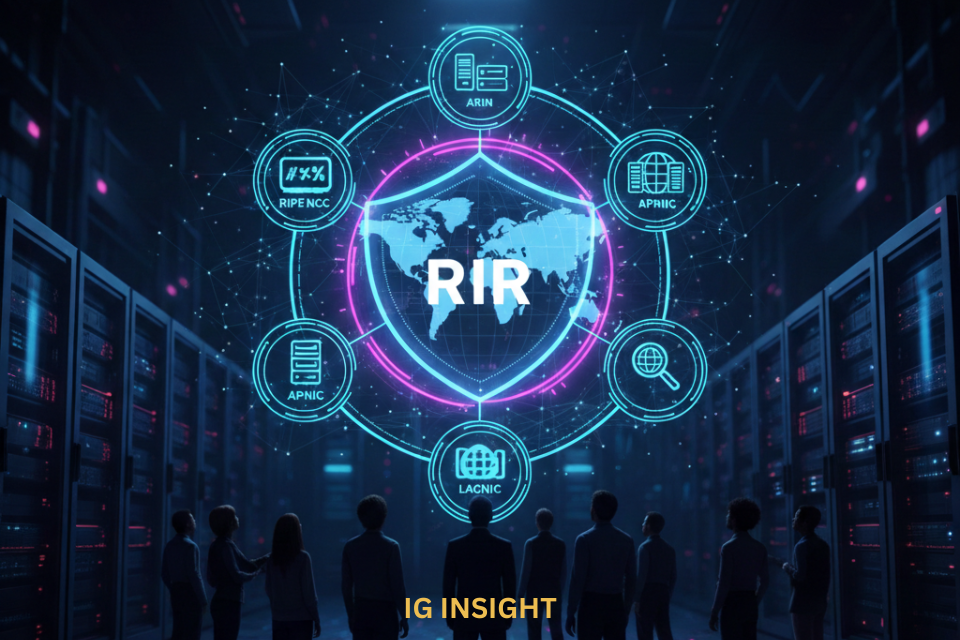
The five Regional Internet Registries allocate and manage IP addresses and Autonomous System Numbers (ASNs) for their respective global regions. They are essential pieces of the internet’s administrative infrastructure.
| RIR | Region | HQ | Key Focus |
| ARIN | North America | Chantilly, VA, USA | IPv6 transition, RPKI deployment |
| RIPE NCC | Europe/ME/CA | Amsterdam, Netherlands | RIPE Atlas, routing security |
| APNIC | Asia-Pacific | Brisbane, Australia | NOG support, IPv6, training |
| LACNIC | Latin Am. & Carib. | Montevideo, Uruguay | Digital inclusion, IPv6 |
| AFRINIC | Africa | Ebene, Mauritius | Capacity building, IXPs, IPv6 |
- All five RIRs have exhausted their free IPv4 address pools — IPv6 migration is no longer optional
- RPKI (Resource Public Key Infrastructure) — the BGP routing security tool — is managed through the RIR system
- RIRs hold open, community-driven policy processes that anyone can participate in
7. W3C — World Wide Web Consortium
The Standards Body Behind the Web You See
The W3C, founded by World Wide Web inventor Tim Berners-Lee in 1994, develops the technical standards for the World Wide Web — HTML, CSS, WebAssembly, accessibility standards, and much more. If IETF builds the internet’s plumbing, W3C builds the web’s architecture.
- Develops HTML5, CSS, SVG, WebAssembly, and hundreds of other web standards
- WCAG (Web Content Accessibility Guidelines) — global standard for accessible web design
- Works on privacy and web tracking (Privacy Principles, WebAuthn, Verifiable Credentials)
- Internationalization (i18n) Working Group ensures the web works in all languages and scripts
- Intersection with Universal Acceptance: W3C standards determine whether IDN domains work in browsers
- Increasingly engaged on AI ethics and governance for web-based AI applications
Internet Governance Organizations: Master Comparison
| Organization | Type | Founded | Members | Core Mandate | Decision Power |
| ICANN | Non-profit | 1998 | Global | DNS coordination | Binding (contracts) |
| IGF | UN Forum | 2006 | Multi-stakeholder | Policy dialogue | Non-binding |
| IETF | Standards body | 1986 | Open/volunteer | Internet standards | Voluntary adoption |
| ISOC | Non-profit | 1992 | Chapters worldwide | Open internet advocacy | Advocacy/grants |
| ITU | UN Agency | 1865 | 193 nations | Telecom & spectrum | Treaty-based |
| RIRs (x5) | Non-profit | 1992–2004 | Regional members | IP address management | Policy binding |
| W3C | Standards body | 1994 | 800+ members | Web standards | Voluntary adoption |
| UASG | Community group | 2015 | ICANN-affiliated | Universal Acceptance | Advisory |
| ccNSO | ICANN Body | 2003 | ccTLD managers | ccTLD policy | Recommends to Board |
| NRIs | Community | Various | National/regional | Local IG dialogue | Non-binding |
The Hottest Trends in Internet Governance (2024-2025)
Internet governance is not a static field. Here is what is reshaping it right now:
1. AI Governance — The Defining Issue of Our Era
Artificial intelligence has burst into internet governance debates with extraordinary force. From AI-generated disinformation to algorithmic bias to the enormous energy demands of AI infrastructure, every major internet governance forum — IGF, ICANN, IETF, ITU — now has AI on its agenda. The UN Secretary-General’s AI Advisory Body report (2024) and the Global Digital Compact are both framing AI governance as inseparable from internet governance.
2. WSIS+20 — The Internet’s Constitutional Moment
The 20-year review of the World Summit on the Information Society (WSIS+20) in 2025 is the most significant internet governance event in a decade. It will determine the future mandate of the IGF, the role of the ITU vs. multi-stakeholder bodies, and global digital development priorities for the next 10-20 years. Every major IG organization is preparing for this.
3. The Global Digital Compact
Adopted by the UN General Assembly in September 2024, the Global Digital Compact (GDC) is a landmark agreement establishing principles for an open, free, and secure internet. It commits governments to multi-stakeholder internet governance, digital inclusion, AI safety, and data protection. Its implementation will dominate internet governance discussions through 2025 and beyond.
4. Internet Fragmentation — The Splinternet Threat
Geopolitical tensions between the US, China, Russia, and the EU are creating real risks of internet fragmentation — a world where different regions operate incompatible internet ecosystems. ICANN has published a dedicated Internet Fragmentation analysis, and IGF 2024 devoted significant sessions to this existential internet governance challenge.
5. Cybersecurity as Governance
Ransomware attacks on critical infrastructure, state-sponsored cyber operations, and the vulnerability of the global DNS system are pushing cybersecurity to the top of internet governance agendas. The Budapest Convention on Cybercrime, the UN Ad Hoc Committee on Cybercrime (AHCC), and ICANN’s DNS abuse frameworks are all evolving rapidly.
6. Digital Inclusion and Connectivity Justice
With 2.6 billion people still offline, internet governance increasingly frames connectivity as a human right. The Partner2Connect initiative, the ITU’s Connect 2030 Agenda, and IGF best practice forums on local content and community networks are pushing governments and industry to close the digital divide — with particular urgency in Sub-Saharan Africa and South Asia.
7. Universal Acceptance — Making the Internet Work in Every Language
The UASG’s push for Universal Acceptance (UA) — ensuring all valid email addresses and domain names work in all software regardless of script or length — is gaining significant momentum in 2024-2025. With ICANN’s new gTLD Round 2 requiring UA compliance, and governments in India, Egypt, and Saudi Arabia mandating UA in e-government services, this is one of the most practical and immediate internet governance wins on the horizon.
Frequently Asked Questions
Q. Who controls the internet?
No single entity controls the internet. It operates through a distributed, multi-stakeholder governance model in which ICANN manages domain names, the IETF sets technical standards, the ITU manages spectrum, RIRs allocate IP addresses, governments regulate nationally, and civil society advocates for users’ rights. This deliberate distribution is considered one of the internet’s greatest strengths — and is also the source of ongoing governance debates.
Q. Is internet governance the same as internet regulation?
Not exactly. Internet regulation typically refers to national laws and rules that governments impose on internet use and services within their jurisdiction. Internet governance is broader — it includes not just regulation, but also the technical standards, coordination mechanisms, international norms, and multi-stakeholder processes that shape the internet globally. Regulation is one instrument of governance; governance encompasses much more.
Q. What is the difference between the IGF and ICANN?
The IGF (Internet Governance Forum) is a UN-mandated multi-stakeholder dialogue forum with no decision-making authority — it produces non-binding recommendations and fosters open debate. ICANN (Internet Corporation for Assigned Names and Numbers) is a non-profit corporation with real contractual authority over the domain name system, registrars, and registries. IGF deliberates on broad internet policy; ICANN implements specific technical policies for DNS and internet identifiers.
Q. What is the multi-stakeholder model and why is it controversial?
The multi-stakeholder model means that internet governance decisions involve governments, private sector, civil society, the technical community, and academia — not just governments. It is the approach championed by ICANN, the IGF, and the broader internet community. It is controversial because some governments (particularly Russia, China, and some developing nations) argue that critical internet infrastructure should be controlled by governments through treaty-based organizations like the ITU, not by a US-incorporated non-profit or open community processes.
Q. What is the WSIS+20 and why does it matter?
WSIS+20 is the 20-year review of the World Summit on the Information Society (which met in Geneva 2003 and Tunis 2005). Scheduled for 2025, it will review progress on digital development goals, determine the future mandate of the IGF (possibly extending it beyond 2025), assess the relevance of ICANN’s current structure, and potentially reshape the balance between government-led (ITU) and multi-stakeholder (ICANN/IGF) internet governance. It is the most consequential internet governance event of this decade.
Q. Can ordinary people participate in internet governance?
Absolutely — and this is one of the internet’s most remarkable features. You can subscribe to ICANN’s public comment processes (free, online), attend the IGF (free for remote participation, fellowship programs for in-person), contribute to IETF working groups (genuinely open to all), join Internet Society chapters in your country, engage with your national or regional IGF (NRI), or participate in ICANN’s At-Large community which represents individual internet users. Internet governance needs more diverse voices, not fewer.
Q. What is internet fragmentation and should we be worried?
Internet fragmentation refers to the risk that the global, unified internet breaks into incompatible regional networks — sometimes called the ‘splinternet.’ It can happen through technical fragmentation (incompatible standards), regulatory fragmentation (data localization and blocking), and geopolitical fragmentation (state-controlled national intranets). Yes, we should be concerned — fragmentation would harm trade, communication, human rights, and innovation globally. ICANN, ISOC, and IGF are all actively working on frameworks to preserve internet unity.
Q. What is the Global Digital Compact and what does it mean for internet governance?
The Global Digital Compact (GDC) is a UN agreement adopted at the Summit of the Future in September 2024. It establishes shared principles for a free, open, and secure internet; commits to closing the digital divide; sets frameworks for responsible AI governance; and reaffirms the multi-stakeholder model of internet governance. For the first time, it also established an Independent International Scientific Panel on AI and an annual Global Dialogue on AI Governance. It is the most significant UN internet governance milestone since WSIS 2005.
Q. How does internet governance affect people in developing countries?
Profoundly. Internet governance decisions determine: the cost and availability of bandwidth in developing countries (spectrum policy, undersea cable licensing); whether government e-services work in local languages (Universal Acceptance and IDN policy); whether local entrepreneurs can access global markets (DNS and e-commerce policy); whether citizens can express themselves freely online (content moderation and shutdown norms); and how digital development aid is allocated (WSIS, SDGs, GDC commitments). For the 2.6 billion people still offline, internet governance literally determines when and how they get connected.
Q. How to Learn Internet Governance Online for Free?
You can learn Internet Governance online for free through global multistakeholder platforms and open learning resources. Explore session materials and discussions from the Internet Governance Forum (IGF), take free courses on ICANN Learn by ICANN, and access technical and policy training from APNIC and APTLD. You can also enroll in free courses via the Internet Society Learning Platform. To strengthen your understanding, read and share reflections on the IG Insight blog.
Final Thoughts: Internet Governance Is Everyone’s Business
The internet did not arrive fully formed from a laboratory. It was built — and continues to be built — through the collaborative, contested, messy process of internet governance.
Every standard agreed in an IETF working group, every policy debated at an IGF session, every domain name dispute resolved under ICANN’s UDRP, every IP address allocated by an RIR — these are acts of governance. They shape the digital environment in which 5.5 billion people live their lives.
Internet governance is not a technical curiosity or a diplomatic niche. It is one of the most consequential fields of human coordination in the 21st century. And it belongs to everyone who uses the internet — which, increasingly, means everyone.
The question is not whether you are affected by internet governance. You are. The question is whether you will be part of shaping it.
Your Voice Belongs in Internet Governance
The internet was built for everyone. Its governance should be shaped by everyone.
✦ Participate in the IGF: intgovforum.org
✦ Comment on ICANN policy: icann.org/public-comments
✦ Join the Internet Society: internetsociety.org/membership
✦ Contribute to IETF standards: ietf.org/participate
✦ Find your national IGF: intgovforum.org/en/filedepot_download/206/2935
The internet’s future is being decided right now. Be part of the conversation.
© 2026 IG Insight Blog. This article is published for educational and informational purposes.

Dipankar Barua is an internet governance advocate from Dhaka, Bangladesh, who believes that voices from the Global South must be heard in the rooms where the internet’s future is decided. As an ICANN advocate and VSIG member, he actively engages in multistakeholder policy processes spanning DNS security, digital inclusion, and responsible AI governance. With an academic grounding in Computer Science and AI, and over 15 years of applied IT experience, Dipankar bridges the gap between technical communities and policy spaces — writing, participating, and advocating for a more open, equitable, and inclusive internet for all.